Welcome to The Aten Sequence series of science fantasy books for young adults and big kids everywhere. Aten is fed up. Who would have thought that a little mistake like forgetting to fill up at the intergalactic service station would get him stuck on a sorry planet at the end of the Universe called Earth. He is desperate to leave, but needs to find huge amounts of gold to make fuel for his ship. So he plans to empty the gold vaults of Karnak Temple. After all, whatever could go wrong?
This is a short story I wrote for a flash fiction competition at Watford Writers.It was my first evening at the writing group and my first entry. I was very proudmy story was voted into second place.
A Jolly Good Catch
We’d always thought of Edmunds as a good catcher and usually
we applauded him for it.
It was a good thing until that night.A good chap to have fielding on the rutted,
makeshift pitches we used for battalion cricket matches.He could catch any ball that came at him,
however fast. He’d always manage to wrap his fingers around it and throw it
back in one rapid, seamless movement.
That night was bitterly cold.There was an iron frost and the sky was full with the cold sparkle of stars.The half
moon threw shadows over No Man’s Land, turning shell holes into pits of stygian
hell. Moonlight glinted off the rifles and bayonets of the dead, strewn like
random, broken puppets across the frozen mud.
We huddled on the fire step waiting for a German raid. The
frigid air carried every sound we made, so each cough, foot stamp and curse must have carried
to the German lines.
All we could hear was crackling frost, distant shelling and
a machine gun chattering down the line.Every time a Very light briefly lit up the dark night we expected to see
the raiding party creeping towards our wire.
We were so lost in our waiting that at first we paid little
heed to the dark object that flew with a faint hissing noise over the parapet.
Edmunds, acting on his famous reflex, stuck out a hand and
caught it.
‘Jolly good catch,’ cried one of the men as another Very
light lit up the sky.
Edmunds looked down and seemed confused by what he’d caught.
‘Throw the bloody thing back over the wire.’ I screamed before
scrambling to get as far away from him as possible.
But Edmunds didn’t move.His usual faultless follow-through was gone.
The thing went off.Ears
ringing, I turned to see Edmunds explode into a human fire ball.I saw his lips move, but could hear nothing
over the roar of the flames.His catch
had probably saved us, but the price he paid was a hideous death by fire.
In the Aten Sequence
Books, our not-so-noble hero Aten has persuaded the gullible Prince Amenophis
that there is a new god in Egypt called Aten, who can only be worshipped
through him. The foolish prince is then
persuaded to embark on a mission to clear all obstacles, including his own elder
brother, out of his way of his becoming the next Pharaoh so he can impose his new
religion on the Egyptians and thus allowing Aten access to the gold he needs stored in
the vaults under the Temple of Karnak. But in Ancient Egypt who or what was the
Aten and how was it worshipped?
Akhenaten worshipping the sun disc
The Aten was the god the ‘heretic’ Pharaoh Akhenaten singled
out from the vast pantheon of Egyptian gods and goddesses to worship. For the first time in Egypt’s long history,
there was only one official deity; only one god who could be worshipped, a god
who could only be approached through the Pharaoh himself. In the ‘Great Hymn to
the Aten’, which many scholars believe Akhenaten wrote himself, the king extols
his god as the creator of life, the source of all nourishment and abundance for
every person, animal, and plant on the planet.
So why did he choose this particular god? The Aten came to
prominence during the long reign of his father, the Pharaoh Amenophis III, so
it was a religious concept which was already developing not something the young
prince snatched out of thin air. The
Aten would have been discussed and worshipped as he was growing up and his
father’s royal palace at Malkata was referred to in ancient times as ‘the
Palace of the Dazzling Aten’.
During this reign the deity is often show with the body of a
man with a falcon’s head. However, references to the Aten or sun disk did start
appearing much earlier in Egyptian history than the 18th
dynasty. As far back as the Middle
Kingdom, there is a reference to this radiant deity in the famous ‘Story of
Sinuhe’. The Aten was depicted as a
yellow or golden sun disk and sometimes the full moon was referred to as the ‘silver
Aten’. The deity’s full name was ‘Ra-Horakhty who rejoices in the horizon, in
his Name as the Light which is in the sun disc’.
When he first ascended the throne Akhenaten was known by his
given name Pharaoh Amenophis IV, but as he gradually embraced his new beliefs
he changed his names, shut down the temples of the old priests and started
building a new capital city entirely dedicated to his new religion on the Nile
at what is now known as Amarna. He declared he would move to his new city,
named Akhetaten, or ‘Horizon of the Aten’, with his wife and daughters and once
there would never leave his city again.
To mark the boundaries of this new capital he had huge boundary stelae
carved into the cliffs.
As Akhenaten was building his new capital Akhetaten, he had
the name of his god carved onto these boundary stelae marking the city limits. Sometimes it was shortened to Ra-Horus-Aten
or just the Aten. From this time forward, the deity was no longer depicted in
human form, but always as the sun disc emanating rays of light culminating in
little hands that offered life, health and prosperity to Akhenaten and his
family. This was not a god for the
people, but a deity which showered its abundance and light on Pharaoh, who then
became a conduit of this divine energy to his country and people. So in a way, it was Akhenaten himself who was
now to be worshipped and seen as a god.
This was nothing particularly new in Egyptian thinking, as
the Pharaoh had always been regarded as a physical manifestation of the divine,
the direct link between the people and their gods. But before there were many, many gods and
goddesses in Egypt that an ordinary person could choose to honour and most
houses had their own little shrines and statues of their favourite deity. With the arrival of the Aten all this was
stripped away and carvings, statues and references to the traditional gods were
torn down or erased.
This new era also completely changed worship in the
temples. Not only were the old gods
gone, but the temples themselves were very different. In a traditional Egyptian temple, there would
have been outer courtyards open to the sun thronging with people, but as you
moved closer and closer into the heart of the complex it would get darker and darker
with fewer people having access. Finally
the shrine of the god would be reached.
A dark chamber of secrets, magic and ceremonies probably only visited by
the High Priest, a few of his senior clergy and the Pharaoh and his queen.
The new Aten temples were vast courts totally open to the
life-giving rays of the sun. There were
rows and rows of offering tables heaped with all kinds of costly foods, drink
and cups filled with smoking incense. In
the so-called Long Temple at Amarna the Egyptologists found the remains of 920 mudbrick
offerings tables in a grid to the south of the temple wall and have estimated
there was as many as another 150 in the central stone-built sanctuary that was,
in the new way, left open to the skies.
It would be nice to think that all this abundance of food, a sure sign
of Pharaoh’s wealth and power, would have been distributed among the people after
the religious ceremonies were over, but there is no evidence for this. It is not even known if the offering food was
cooked on site or taken away to be prepared for feasting at the palace or a
more humble family’s dinner. Or was it
just left for the god, rotting away under the merciless heat of the Egyptian
sun?
Another unusual feature of these new temples was that there was
no cult statue of the deity, which had to be washed and dressed in fresh
clothes every day. Because the
interlinking courtyards and the inner sanctuary were all open to the sky, the
sun disc was worshiped directly, by tracking its daily progress from where it
rose in the east and set in the west.
There were priests in the Aten temples, but Akhenaten himself presided
over some of the worship; acting as a High Priest and leading the other
worshippers in reciting or singing ‘The Great Hymn to Aten’ and other
prayers.
The royal ladies of Amarna played an unusually prominent
part in this worship, and Akhenaten’s queen Nefertiti was usually shown the
same size as her husband, accompanying him with their six daughters in all his
activities. One of the great honours
that could be bestowed on these royal women was having a small, open cult
shrine, known as a ‘sunshade’ or ‘kiosk’ dedicated to them. One of the features of the Amarna period was
a turning away from the stylised art and formal depictions of gods and people
towards a more natural style of art showing beautiful scenes of trees, pools,
animals and all the bounty nature had to offer.
These ‘sunshades’ were often set in beautiful, sunlit surroundings where
there was pools containing fish and colourful plants and flowers. They created an oasis of tranquillity,
somewhere for the women to come where it was quiet and peaceful, a place for contemplation
and prayer.
But even here human conflict crept in. In one of the larger known sites for the ‘sunshades’
called the Maru-Aten, the names and titles of one Amarna royal lady was erased
and recarved with the names and titles of Akhenaten’s oldest daughter Princess Meritaten. It used to be thought that it had been her
mother Nefertiti’s name which had been removed, but now many Egyptologists
believe that it was the name of one of Akhenaten’s other queens, Kiya, which had
been struck from history.
For all its glittering brilliance, the cult of the sun disc
and Akhenaten’s new capital city were to last for less than twenty years. This self-imposed exile and concentration on
religion rather than affairs of state had weakened the Egyptian empire. There
is also some evidence that a plague which was sweeping through the Middle East
at that time, reached the Egyptian court killing some of the female members of
the royal family. When Akhenaten died
there were a few shadowy years were who his successor was is disputed, some
scholars thinking it was a young king called Smenkhare and others that Queen
Nefertiti seized the throne and ruled on her own.
But a few years later, when the young boy king Tutankhamen
came to the throne, the capital was moved back to Thebes, the temples and old
gods were reinstated and the names of Akhenaten and his god were erased. Unfortunately Tutankhamen was destined to die
young and the glittering 18th dynasty came to an end with the reign
of Horemheb, who saw to it that any last traces of this religious experiment
were destroyed forever. Akhetaten had
been hastily constructed of mudbrick and any stone which had been used was
stripped and used elsewhere, so it swiftly fell into disrepair and
crumbled. The tombs which had been
carved in the hillsides were left empty and no more offerings were made in the
temples.
Gentle Reader, I have a confession I wish to make – I have
not done it. Yes, I freely admit I have
not done it. I am Cynthia Marsh, author
of this parish and I have not done it! I
have not been sending my books out to review sites and have been very lax in my
marketing. There I’ve said it! Been honest and stopped hiding behind the too
busy, must take my plant to the vet or I got stuck in an airport in Azerbaijan with
no internet access excuses.
Now the more practical and level-headed of you out there are
probably puzzled right now. Thinking ‘how
does she think she’s going to sell any books if she doesn’t put herself about a
bit and do some marketing?’ Well of
course you are all right, ‘write it and they will come’ doesn’t quite cut the
mustard in today’s cut and thrust world of short attention spans and millions
of other things to read.
Hall of the Golden Crocodiles - The Aten Sequence 2
So what stops authors blowing their own trumpets, sending
their books into the world and marketing the hell out of them? After extensive and long-drawn-out analysis
(time I could have more profitably spent in writing a few more blog posts or
annoying a few more book reviewers) I would have to say it is fear. Scalp-numbing, blood-freezing, visceral fear!
You have spent months, if not years,
working on your novel, short stories or poetry and now you are expected to send
it out there to a bunch of strangers who have the power to dismiss it entirely
with a few, well-chosen words. Or even
worse, ignore it entirely.
The only situation I can liken it to is when mother’s
anxiously prepare their kids for their first day at school or play group. They dress them up smartly, make sure they
have enough felt pens and crayons to compete in the pencil case wars, pack up
their lunch and deliver them to the school door. And for perhaps the first time in their child’s
short life they will have no control at all over what is now going to happen in
their child’s life. Will they be
liked? Will the teacher understand they
don’t like carrots? Will people know
that he only pokes his tongue out at people because he’s scared?
Well that’s a bit like how you feel when you are ready to
launch a new book onto the unsuspecting public.
There aren’t enough back-page blurbs and plot synopses in the world to
really allow you to convey what this piece of fiction means to you, the endless
hours you spent agonising over every little word and punctuation mark and what
your protagonist really meant on page 72, fifth line down. And the worst thing
to swallow is that you know that nobody really cares.
Because readers are buying a finished product, a book that
can entertain, take them away from reality for a few hours, inform or make them
think, and the author’s journey in producing that product is just an
interesting little titbit for the author bio on Amazon.
Cynthia Marsh - author of The Aten Sequence Books
So what we authors really need is a much thicker skin,
something many creative people lack.
There are many writers out there, of course, who are doing really well
and making lots of money, because they have overcome their fears, or never
doubted the quality and saleability of their work in the first place. They may not even necessarily be the best
writers in the world today, but they have the guts and drive to get out there
and market their books, so they fully deserve all the success that comes their
way.
I did read somewhere recently that most procrastinators are
actually perfectionists and that is why they are so bad at starting new
tasks. I think a lot of authors, me
included, are like this. We can fuss,
revise and edit for years but at some stage we will have to admit there is no
such thing as the perfect book and get on with it. And when we do that, it frees us up to write
the next book and then the next one and our writing improves because we are
doing more of it.
And because no book is perfect, we authors just have to get
used to the reality of bad reviews. As
an author you simply can’t please everyone.
Someone out the, and probably quite a few someones, will not like your
book. They will not like the cover, they
will not like the genre, they will not like the characters, the plot or the dialogue. And this is Ok as they have a perfect right
to not like your book, even if it took twenty four years and several nervous break
downs to write.
If you get a bad review, all you can do as an author is
accept the fact somebody did not like your book and take on board any
constructive criticism they made. After
all, you want your writing to improve right?
Instead of viewing it as an attack on your precious oeuvre, thank the
reviewer and take it as a chance to get a different perspective and an
opportunity to learn and develop your writing skills. Of course, writing a bad review is not the
same thing as a reader attacking you personally as an author. These types of reviews are best ignored and
are not even worth the energy of a reply.
Unfortunately, the world of the internet is full of trolls trying to get
a rise out of people, so take heed of the signs and do not feed the trolls.
But even though I have said I have not done my marketing, I
have to confess to doing a little. This
led to a delightful book reviewer called Kathy Ree reviewing ‘Hall of theGolden Crocodiles – The Aten Sequence 2’ on her blog ‘Kitty Muse and Me’ and
also posting the review on Amazon in the States. This is where the ecstasy of book reviews
comes in. When you see those five little
stars and realise someone else has loved your book. Someone, moreover, who was not your mother,
best friend or the guy down the road you promised a beer to if he read them all
and posted reviews. So I can’t thank
Kathy enough for giving me my first independent book review in the US and a
good one at that!
Yes book reviews can be agony, but they can also be ecstasy
and, like it or not, you are not going to sell many books until you get
them. Readers these days want to know
other people have read the book, they are reluctant to be the first. Surprisingly, bad reviews do not do as much
harm as you may think, as a large percentage of
reviews for ’50 Shades of Grey’ were not that flattering, but they still
encouraged others to buy it.
If you are one of the rare outliers who will read books that
catch your fancy that are still unknown, do the author a favour and write that
review for them. A few short sentences
is all it takes and the writer will love you forever!
Aten wants gold, more gold and more gold. And then he has to work out how to make the fuel he desperately needs so he can get back to conquering the Universe with his Uncle Lucie. While he tries to work out how to get into the massive treasure vaults beneath Karnak Temple, he sets up a little tomb robbing ring. Aten’s goal is to find intact royals tombs brimming with gold treasure. Finding an intact royal tomb in the Valley of the Kings is also the dream of many Egyptologists today. But was the tomb of the boy king Tutankhamen the last big discovery that the Valley of the Kings will yield or are there more amazing finds just waiting to be unearthed?
The discovery of the tomb of a minor pharaoh from the end of the 18th dynasty in 1922 by Howard Carter and Lord Carnarvon rocked the world. Never before had an almost intact pharaoh’s tomb been found in the Valley of the Kings, and this discovery gave us not only fabulous treasures but a great deal of valuable information on the end of the Amarna period. But is the boy king’s tomb the last great discovery to be made in the Royal Necropolis or are there more undisturbed tombs hidden in the cliffs and valley floor waiting to be found?
Excavation in the Valley of the Kings - November 2008
That there are many tombs yet to be unearthed in Egypt has been amply demonstrated over the last few weeks. In Abydos, the sacred heart of Ancient Egypt, a huge quartzite sarcophagus discovered a year ago has been identified as belonging to an obscure pharaoh of the 13th dynasty called Sobekhotep I, leading to the discovery close by of the tomb of a previously unknown king. Hieroglyphs painted on the tomb walls gave his name as Senebkay. And just around the corner from the Valley of the Kings at el-Khokha, a beautifully painted tomb of a courtier from the Ramesside Period is being excavated. The tomb belonged to the Chief Brewer of the Temple of Mut called Khonsu-em-heb and the exquisitely painted frescos show him and his wife Mutemheb feasting and making offerings to the gods. So could there possibly be more royal tombs waiting to be found in the Valley of the Kings?
The first burial in the arid, remote valley was a departure from tradition. In earlier dynasties, pharaoh’s tombs had been built in plain sight as a sign of their power and prestige. From the earliest mastaba tombs to the pyramids, these tombs were as large and lavish as the pharaoh’s treasury and length of his reign allowed. Even as late as the 17th dynasty, pharaohs were buried in small pyramids at Dra’ Abu el-Naga, a necropolis in the Theban hills. So why did a high court official called Ineni dig a rock cut tomb for his royal master, boasting ‘alone, no one seeing and no one hearing’? Possibly because it was becoming obvious that most of these ostentatious, very visible tombs were being entered by tomb robbers, who stole the precious funerary treasure and ripped the pharaoh’s mummies apart looking for amulets and jewellery.
Valley of the Kings
But although it might have been possible to conceal the location of one royal tomb, as successive pharaoh’s carried on digging their tombs in the same valley, the site of the royal necropolis became well known and a workmen’s village was built at Deir-el Medina to house the men who dug and decorated these fabulous sepulchres. To date sixty four tombs have been found in the Royal Valley, belonging to queens, royal children and favoured courtiers as well as the mighty pharaohs themselves. So who is missing? Which pharaoh’s tombs have not yet been found? The two main contenders are Thutmosis II from the early 18th dynasty and Ramesses VIII from the 20th dynasty. The mummy of Ramesses XI has also not been found and though a tomb was dug for him in the Valley of the Kings, there is no evidence he was actually buried in it. Most of the tombs of the queens from the 18th dynasty have also not yet been located and there may also be smaller tombs of princes, princesses and royal officials still awaiting their turn to be discovered.
In 2007 Dr Zahi Hawass appointed an Egyptian team of archaeologists headed by Afifi Rohiem to start excavating in parts of the Royal Valley where he believed there might be a new tomb. At the same time the Glen Dash Foundation for Archaeological Research undertook thorough ground-penetrating radar investigations of the cliffs and valley floor. The Egyptologists worked between 2007 and 2010, starting with the area around the tomb of Merenptah. Their excavations rediscovered some ancient graffiti first recorded by Jaroslav Czerny and the remains of some workmen’s huts, which have been carefully recorded. Tantalisingly, one of the ancient graffito was written by an official called Userhat who said that he had created a burial for his father close by.
The Egyptian found two cuttings in the rock that could be tomb entrances, one where the rubble has been disturbed, suggesting that whatever is there has already been disturbed, and one where it had not. Could this be the entrance to an intact tomb? These two new tomb entrances became known as KV64 and KV65. The KV64 entrance was found close to Merenptah’s tomb and is Ramesside in appearance. It was thought this could possibly be the entrance to the tomb of Pharaoh Ramesses VIII. The other tomb entrance was cut and in the style of the 18th dynasty and Dr Hawass stated in a lecture that he thought this could be the tomb of an individual from the Amarna period and that some debris has been excavated that had the name of a previously unknown queen on it.
However, for some reason no further investigations of these tomb entrances were undertaken, possibly they were halted by the civil unrest that started during 2011. In January 2012 a team from the University of Basel in Switzerland stumbled across a new tomb in the valley completely by chance. When they opened it they found it contained the undisturbed coffin and beautifully wrapped mummy of a temple singer called Nehmes Bastet dating from the 22nd dynasty. The tomb, now officially designated as KV64, was not originally built for her but had been usurped from an earlier period. The inscriptions show that Nehmes Bastet was the daughter of the High Priest of Amun, so are there more burials from this family and period still awaiting discovery in the Valley?
So there is a strong chance there are still some major finds to be made in the Valley of the Kings. KV63 is now thought to have been more of a storage chamber for burials of the Amarna period, rather than a royal tomb. Most of the burials of the royal ladies of this period have not yet been located and finding the tomb of one of the major figures, such as the iconic beauty Queen Nefertiti, would be very exciting and help to clarify what really happened during this shadowy part of Ancient Egyptian history. The mystery tomb KV55 could be the tomb of the heretic Pharaoh Akhenaten or his ephemeral successor Smenkhare, so is either of these king’s tombs still concealed in the cliffs somewhere?
Western Branch of the Valley of the Kings
We also still do not know the complete family tree of the pharaoh’s or of their court officials, so there could be tombs to be discovered that belonged to queens, royal children, ladies of the harem or nobles we have never before encountered in Egyptian history. Also all the tombs visited by tourists are in the eastern branch of the Valley of the Kings. There is a western branch that contains the tombs of Amenophis III and Ay that is rarely visited and has not yet been thoroughly surveyed or excavated. But although a tomb stuffed full of golden treasure would captivate the media and the public the world over, any find, however small, adds to our knowledge of our ancient past and fills in another piece of the puzzle.
In The Aten Sequence Books the main character Aten sends Luke and Neferptah to be educated with Prince Dhutmose and other noble boys in an educational institution called the ‘Kap’, situated in the royal place. But what was life really like for a schoolboy in Ancient Egypt? What were they expected to learn and how were their lessons taught?
What was it like to be a schoolboy in Ancient Egypt? Formal education was mainly reserved for the upper classes and boys from wealthy families would begin their schooling around the age of four. They would be trained in all the skills they would need to follow in their father’s footsteps. A boy’s future occupation was decided by his family and they usually entered the same profession as their father. Many important positions at Pharaoh’s court and in the major temples were handed down from father to son for many generations. The Ancient Egyptians were also a very practical people, so children were taught only the subjects and skills that would be relevant in their later career.
Child Working in Garden - Tomb of Menna
Literacy was mainly confined to the ruling classes such as courtiers, state administrators, senior members of the priesthood, and important army officers. The artisans at the workmen’s village at Deir el-Medina who worked on the royal tombs in the Valley of the Kings and the mortuary temples of the west bank could also read and write and, most unusually for the ancient world, there is evidence that some of their wives and daughters were also literate. These workmen needed literacy skills as they had to accurately carve or paint texts onto tomb and temple walls from papyri or ostraca. Any Egyptian who was literate was known as a ‘scribe’ and the ability to read and write was so highly valued that many important courtiers and officials had statues carved that depicted them as scribes with a roll of papyrus stretched out across the knees.
School started early in the morning and would generally take place at the teacher’s house. Boys were required to bring their own lunch and would pack bread and beer to keep them refreshed until the lessons ended at noon. Teachers were very strict and the lessons would be made up of copying from old hieroglyphic texts and memorising passages from stories and texts. Papyrus was very expensive, so students would practise their writing on fragments of limestone called ostraca or pieces of broken pottery. If the teacher thought a pupil was being lazy, was caught sleeping in class or had been disruptive, then the punishment could be harsh as they would be beaten across the back with a stick. Arithmetic was also taught but, although texts were recited out loud in order to learn them, all mathematical calculations were done silently and not spoken aloud.
The lessons were very difficult as the students would have to learn both the hieroglyphic and hieratic scripts. Hieroglyphics were the formal version of the script and were used in tombs, on temple walls and on the possessions of royalty and important noblemen. Hieratic was developed around the same time as the hieroglyphic script and was a simplified version that was used for more mundane purposes such as keeping accounts, making records and private correspondence. There were many different hieroglyphic signs to learn, over 700, all of which were consonants. There were no vowels, and the grammar was also difficult.
When writing in English we write from left to right across the page, but Egyptian schoolboys could right from top to bottom or across the page. If writing across the page, the text could be started from either the left or right. The way they would know which way to read the text was to look at which way the animal, bird or people signs were facing; if they were facing right, the text was to read from right to left. Writing was regarded as sacred by the Ancient Egyptians as they believed it had been given to them by the gods, so texts had to be perfect, with no mistakes and neatly presented. The schoolboys would use brushes made from reeds to do their work, which they would dip into either black or red ink. The ink, along with the reed pens, was stored in a pallet that was generally made from wood, although more elaborate ones were crafted in ivory or gilded. Black ink was made from soot and water and other colours were made from mixing water with ground up minerals.
Physical education and military training did not really come to the fore until the time of the New Kingdom when the army came to more prominence and senior army officers began to wield great power in the ever growing empire. Young royal princes and scions of the nobility were brought up and educated in an institution called the ‘kap’ or the Royal Nursery. The ‘kap’ was part of the royal palace and having been a ‘child of the kap’ conferred a great deal of prestige in later life and was often mentioned on the owner’s statues and tomb inscriptions. Foreign princes and nobility were also sent to the Royal Nursery, or brought as hostages, to be educated alongside the future pharaoh. This may have been done to forge strong personal bonds between the crown prince and the young men who would go on to rule the satellite states of the Egyptian empire or to ensure the continuing good behaviour of their fathers. Not all who gained the coveted title of ‘Child of the Nursery’ were from the highest levels of society; some young boys came from relatively humble beginnings, such as the draughtsman Nebseny, although their career prospects were bound to have been boosted from their early proximity to the highest in the land.
Hieratic Text Copied by Schoolboy
These privileged young men would have been trained in archery, hunting, chariot driving, swimming and fighting with sticks. Pharaohs had always been portrayed as accomplished warriors and athletes, but by the time of the New Kingdom the heir to the throne was shown and described engaging in amazing feats of arms and athleticism. Most of these images probably portrayed rituals rather than real life events, but the Egyptians doubtless looked up to their kings as physically powerful and fearless fighters.
Parents also taught their children the stories of the gods, religious rituals, ethics and morals. There were texts called Books of Instruction or Wisdom Literature, which stressed desirable precepts such as veracity, treating people fairly, being obedient, leading an ordered life and taking responsibility. The Ancient Egyptians tried to live by the principles of Maat, personified as a goddess, which created prosperity and balance in the country. These principles were harmony, cooperation, justice, truth and decorum. Punishment for not following these ideals was believed to come after death, when your heart was weighed on a scale against a feather of Maat. You would only be allowed to move on to a joyful, prosperous afterlife if your heart balanced the scale. However, if during your life you had murdered, lied or cheated your heart would be too heavy, so it would then be flung to a demon called Ammut to devour and your life would be ended forever.
Palette of a Scribe
Children from poorer families started working and being useful from an early age. So you can see images on tomb walls of children helping with the harvest, herding animals, fishing and many other tasks. They would have been trained by a close family member such as their father or uncle, and would have been expected to contribute economically to the household from very early on. Girls were not educated as formally as their brothers, although there is evidence that royal princesses were taught to read and write. However, they would be taught by their mothers how to do all the daily household tasks and maybe also how to sing, dance and play instruments. These skills were especially useful for the girls who went to be a singer or a dancer in one of the many temples.
So the life of an Ancient Egyptian schoolboy was regimented and they were expected to be diligent, respectful and follow the path laid out for them by their family. Much more was expected of them at an early age than would be today, but life expectancy was typically only between thirty and forty. Children had to grow up faster and work hard to make their mark in a world that could be tough andunpredictable. Hieratic text image Wafulz on Wikimedia Creative Commons Attribution 3.0 Unported Child Working in Garden - Tomb of Menna image Wikimedia Commons Public Domain Palette of a Scribe image Wikimedia Commons Public Domain
In The Aten Sequence Books, our hapless main character Aten is desperately trying to get his hands on enough gold to make more fuel for his ship, so that he can blast off back into space and join his evil Uncle Lucie in conquering the Universe. After trying out a few options, such as the Bank of England in Victorian London, he decides the Temple of Karnak during the reign of the fabulously wealthy Pharaoh Amenophis III is his best bet. Now this is pure fiction, but the Ancient Egyptians were famous for the amount of gold they possessed, so why was it so important to them?
“And gold – everywhere the glint of gold” - Howard Carter on what he saw as he opened the tomb of Pharaoh Tutankhamun in the Valley of the Kings.
Cobra Details on Tutankhamun's Gold Throne
Most people when they think of Ancient Egypt think of gold. Ever since the glittering tomb of the boy king Tutankhamun was excavated in 1922, we have associated the mysterious land of Egypt with untold wealth and glittering treasure. It seemed as though every exquisite piece of funerary equipment removed from the tomb was gilded in the precious yellow metal or even made entirely of solid gold, like the famous funerary mask and inner coffin. And if this was the treasure placed in the tomb of a relatively insignificant pharaoh who only ruled for a few years and died young, what wealth could the tombs of the mighty kings such as Ramesses the Great and Thutmosis III have contained before they were robbed?
But why was gold so important to the Egyptian pharaohs? It was not a precious metal used by the ordinary people; it was reserved for the exclusive use of royalty and important nobility. Domestically it had no economic value, as barter was used for trade and all servants of the crown were paid with food, fuel and gifts. Money was not used in Egypt until the Ptolemaic period, so gold was not used in coins. One of the reasons it was so highly prized was that it was associated with the dazzling light of the sun and the solar deity Ra. It was believed that the very skin of the gods was golden and that their bones were composed of silver. Because it is a precious metal that does not tarnish and is fairly indestructible it was also associated with eternal life. The pharaoh was viewed as divine, the human link between the earth and the numinous, so gold was used for royal coffins and funerary equipment to help preserve the king’s mortal remains for eternity.
It was in international trade that gold became important, and Egypt became famous for the amount of the prized precious metal that it sent to all corners of its far flung empire. It was not only used for trade, it was also an important diplomatic tool as pharaohs would send quantities of gold and gilded treasures to their allies and vassal monarchs in order to keep them happy and fighting to maintain Egypt’s borders. So used were these vassal kings to having a continuous flow of gold being sent out to them that they would write and complain if there was any disruption in supply. In the late eighteenth dynasty King Tushratta of Mitanni wrote to Queen Tiye to moan that her husband Amenophis III was only sending gilded statues not the solid gold ones he had apparently promised:
‘I have asked Mimmuriya, your husband, for massive gold statues. But your son has gold-plated statues of wood. As the gold is like dust in the country of your son, why have they been the reason for such pain, that your son should not have given them to me?’
Gold was also given as rewards to courtiers and military leaders. Reliefs at Amarna show the royal couple Akhenaten and Nefertiti handing out golden collars and arm rings to their faithful followers and large flies fashioned from gold were handed out for valour on the battlefield, much as we give out medals today. Interestingly these military awards were sometimes even presented to women, as Queen Aahhotep I, the mother of Pharaoh Ahmose I, was buried with three such flies in her tomb.
As the wealth and might of the Egyptian empire grew in the New Kingdom, so did the prestige of goldsmiths. The men who created the exquisite jewelry, statues and funerary masks became feted and wealthy in their own right. They developed several techniques that are still used by jewellers today such as utilising the lost-wax technique to make intricate statues, beating gold into fine leaves, and mixing it with other metals to create alloys.
Electrum, a blend of gold, silver, copper and other metals, was one such alloy that was very widely used to plate the exterior of monuments such as obelisks and the pyramidions that topped the pyramids.Gold had been mined and worked in Egypt since predynastic times. How it was first discovered is shrouded in mystery, but this very early gold was more than likely extracted from alluvial deposits.
It was one of the first metals to be worked and used by prehistoric man, probably because it could be found in the natural world that surrounded them, is very malleable and soft so can easily be worked with rudimentary tools, and its shine and glitter would have made it attractive for use in jewelry and ornaments. Most of the gold extracted in antiquity in Egypt was mined in the Eastern Desert and Nubia. In fact Nubia even incorporates the ancient word for gold ‘nub’ in its name.
Ay receiving rewards of gold from Akhenaten & Nefertiti
All of the mines in Ancient Egypt were state monopolies and were worked predominantly by prisoners and slaves. According to the writings of the historian Diodorus Siculus in his Bibliotheca historica written around 60 BCE these unfortunate souls were treated very badly; being made to work in appalling conditions, with little food or water and being beaten if they weren’t thought to be working hard enough.
The methods of extracting the metal were simple but effective. The earliest method used was probably extracting gold from auriferous sand, which was known in antiquity as nub-en-mu or ’gold of the river’. Quantities of auriferous sand would be placed into a sack made from an animal fleece, with the woolly side facing inward. Water would then be poured into the bag and vigorously shaken around by two men. This would separate the heavier metal from the dirt and grit and when the water was drained out, it would take the dirt with it leaving the gold dust adhering to the fleece.
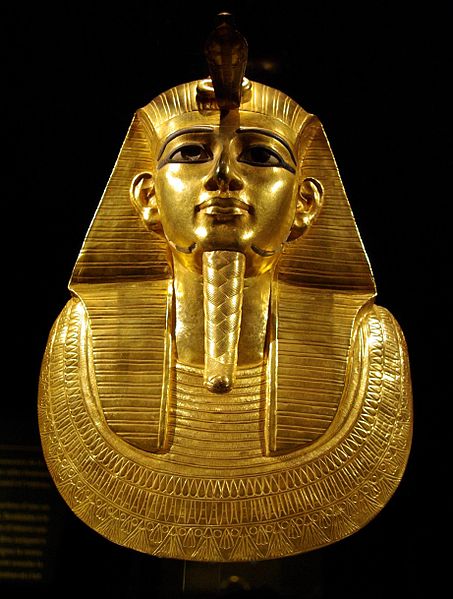
Funerary Mask of Psusennes I
Shallow underground mining probably didn’t start until the New Kingdom and this technique of extraction was known as nub-en-set or ‘gold of the mountain’. The metal bearing rock was first crushed into powder and then spread over a stone table that was slightly tilted. Water was then poured over the powder, which separated all the dirt and dust from the metal, leaving only the particles of gold on the table. This was repeated a few times until only gleaming, yellow metal particles remained. They then rubbed these precious particles between their hands for a length of time, before they finally ran small sponges over it to clear out any remaining dirt.
So far there have been over a hundred gold workings and settlements that have been found, most of them in the arid wadis of the Eastern Desert. However, according to the map on the Turin Papyrus, there were at least 1300 such mines in ancient times. Hopefully, more evidence and remains of the ancient gold mining industry will be excavated from beneath the sands of Egypt, as well as further beautiful examples of the ancient goldsmith’s art.


.JPG "Western Valley of the Valley of the Kings - own image")