Tuesday, 7 May 2013

Writing Success – You Might Want To Start Telling a Different Story


What is your definition of writing success?  Is it rave reviews, worldwide fame, number of books sold, cash in the bank or the fact that your nearest and dearest think that your book is the best thing ever written since Shakespeare laid down his quill? Since I self published my first book in the Aten Sequence, Pharaoh’s Gold, like most newbie authors I have been reading all the blogs and forum posts about how to be a great author and promote my books.

Whitsunday Islands, Australia
Is this what success looks like? Yes please!


It seems like everyone has an opinion, which is great, but also that they believe that the way they have carved out their success is the only way to go. Some of these posts have led to panic and a sinking pit in my stomach that my books will never be a success and guess what – that it is all my fault! Yep, it’s totally my fault.  I didn’t read the post about beginning to promote my book at least a year before I released it on to the unsuspecting public, I haven’t sent it out to thousands of reviewers, I haven’t sent out press releases, done signings in coffee shops, tweeted my little heart out, amassed 10 million Facebook fans or any of the other myriad things that I have read that I MUST do or my books don’t stand a chance.

Now I’m not knocking any of the above marketing tools, they are all valid and have worked for many people.  What I think that I’m trying to say is that if you get too caught up in reading all the writing and publishing advice out there, it can literally paralyse you.  The task is too big, the amount of work formidable and only someone with the iron determination to work twenty four hours a day with no distractions will be successful and deserves to be successful.  Yes, you heard the word correctly – deserves.  There is a real evangelical, whip yourself until the blood runs feeling out there in author blogland.  You must at least half-kill yourself to succeed or you do not deserve it! I have learned that pure luck or success springing from nowhere seems only to inflame the mob, leading to howls of outrage and hisses of disbelief.  To earn your success, you have to suffer.  You have to be able to sit in that interview chair at the end of it all, dripping wounds on show, telling it like it was - a true tale of torture and suffering.


Now in my naivety I thought that stringing together around 70,000 words in a vaguely coherent story was the real hard work, so I was a bit shocked when I read that I still had the big mountain to climb.  For several months I panicked, I floundered around; I did a bit and then didn’t do most of it.  I felt totally overwhelmed by this huge, seemingly insurmountable obstacle that had been placed in front of me.  How was I even going to start building that shiny author website with lots of singing, moving gizmos and buttons?  What about all these book signing gigs, talks and radio shows?  How are all these other people doing it?

But after a lot of deep breathing, I decided that I needed to write another success story, one that was uniquely my own.  It took a lot of sifting through my beliefs, taking a hard look at all the things I have read and learned and examining my own priorities before I came to a startling conclusion. And this conclusion was that success for me was the pure joy and exhilaration I got from writing my book.  It was the process of crafting the story, creating the characters and bringing their very world into existence.  I have self published the first book in the Aten Sequence, am about to release the second and am currently writing the third. 

These characters I now know as well as my own family and friends.  Even if I don’t write every day, I will still be thinking about them, plotting a new part of the story or trying to change a bit I have already written to make it better.  Aten, Druitt, Neferhotep, Merytamen, Luke and all the others are now my mates; friends that I spend a lot of time with.  For the first time, I am killing off one of my characters and it is bringing a lump to my throat as I write the words that seal his fate.

Writing success for me is the joy I feel every day when I sit down at my laptop and continue my story or start writing a completely new one.  There are so many different characters out there, so many situations, events and emotions that I know that I will never run out of words.  Not even if somebody offered me £1 million to stop writing would I take it, because it is a part of who I am.  Writing for me is happiness, freedom, exhilaration and fulfilment.

 Every author is different and on their own path to success, so my advice would be to take on board any knowledge, tips and tools that resonate with you, that you know you are going to enjoy working with and just go for it. More importantly, know that trusting your own instincts and following your heart will lead you more surely towards your goal than any advice given by others, however well meant.


Do I want my Aten Sequence books to be read by lots of other people? Do I want to find fame and fortune with them? Yes of course I do and I know that I will probably have to use some of the marketing and promotional tools that luckily we now have available to do it.  But I’m open to experiencing pure luck and being an overnight success with no effort involved.  I’m going to stop beating myself up about what I don’t do and give myself a big pat on the back for what I do get done.  For me, the path to success is no longer through suffering and hardship. I’m going to spend my precious time doing more of what lights my life up, which is writing.  I’m going to start writing myself a different success story.

Saturday, 6 April 2013

Egyptian Pharaoh Sneferu and His Overachieving Children


The fourth dynasty Pharaoh Sneferu is alluded to in the first two books of the Aten Sequence, because he was regarded by later Egyptians as a wise and benevolent ruler.  But this Old Kingdom Pharaoh has a much larger part to play in the third book of the series, but you will just have to wait until it is released to see how Luke and Neferptah get into trouble with a long dead ruler.

Have you heard of the Pharaoh Sneferu? There have been powerful royal families and dynasties throughout history, but if we travel back to Ancient Egypt’s Old Kingdom we find a family who all seemed to be high achievers and whose monuments still stand today, including one of the Seven Wonders of the Ancient World. The founder of this amazing family was the Pharaoh Sneferu, who was also the first king of the 4th dynasty.  Sneferu’s own parentage is still disputed.  Some scholars think that his father was his predecessor and last king of the 3rd dynasty, the Pharaoh Huni and that his mother may have been one of the lesser wives or concubines of Huni called Meresankh. Sneferu was the pharaoh who brought pyramid building in Egypt to its full fruition and remarkably built three major stone pyramids during his reign, the Meidum pyramid and the Bent and Red pyramids at Dashur.  

Red Pyramid of Sneferu at Dashur - own image
Red Pyramid of Sneferu at Dashur


He was a pharaoh who was also admired by later Ancient Egyptians for being a wise and benevolent ruler. He had several wives and many concubines, as was the custom in Ancient Egypt and his Great Royal Wife is believed to be a lady called Queen Hetepheres I. Hetepheres I was probably a daughter of Huni and therefore may have been Sneferu’s half sister, but marriages between brothers and sisters or even fathers and daughters were common in the royal family of Ancient Egypt.  To a certain degree the succession of the Egyptian crown was matrilineal, as the next Pharaoh tended to be the son of the Great Royal Wife or a wife of royal blood. These marriages were entered into to ensure that the succession to the throne remained within the immediate royal family and marrying his close female relatives strengthened a king’s position and power immensely.


So you would think that having as mighty a Pharaoh as Sneferu for a father would be a hard act to follow?  Well his kids did not seem to think so, as it was his son Khufu who succeeded him as pharaoh and went on to build the Great Pyramid at Giza, a miracle of ancient engineering. Khufu was a son of Sneferu’s Great Royal Wife Hetepheres I and was not remembered by later generations as benignly as his father, as he goes down in folklore as being a particularly cruel and implacable ruler. The length of time a pharaoh ruled is often disputed by scholars, but it is believed that Khufu ruled for around 23 years.

Apart from his amazing achievement of building the Great Pyramid of Giza as his tomb, it is believed that he led expeditions into Nubia, the Sinai and Libya.  The relationships of the 4th dynasty royal family have been pieced together from ancient histories, inscriptions and monuments and some of them are by no means certain and many are still been disputed. Khufu is believed to have had several royal wives, including queens called Henutsen and Meritites I and two further queens whose names are not yet known. Meritites I and Henutsen were both half-sister’s of King Khufu and daughters of Sneferu.


Khufu had many brothers and sisters and the ones that we do know something about all held high office if they were men, or married powerful courtiers if they were women. Khufu was not, in fact, Sneferu’s eldest son, even though he succeeded him on the throne.  According to inscriptions, the eldest son was Prince Nefermaat I.  Nefermaat I’s mother is unknown, but he was the acknowledged Crown Prince as well as holding some other impressive titles such as Vizier, Seal Bearer and Prophet of Bast. Nefermaat I was married to a lady called Itet and they were both buried in a mastaba tomb at Meidum that is famous for being where the glorious tomb painting known as the ‘Meidum Geese’ was found.  They had a very large family, but possibly their most famous son was Hemiunu who was credited with being the architect of his Uncle Khufu’s Great Pyramid at Giza.

Prince Ankhhaf was another younger half-bother of Khufu.  We do not know who his mother was, but he married his half sister Hetepheres, who was a daughter of Hetepheres I. He served as Vizier under his nephew the pharaoh Khafre, who was a son of Khufu and Henutsen. He was buried in a large mastaba in the eastern cemetery at Giza and a particularly fine statue of him can be seen in the Boston Museum of Fine Arts.

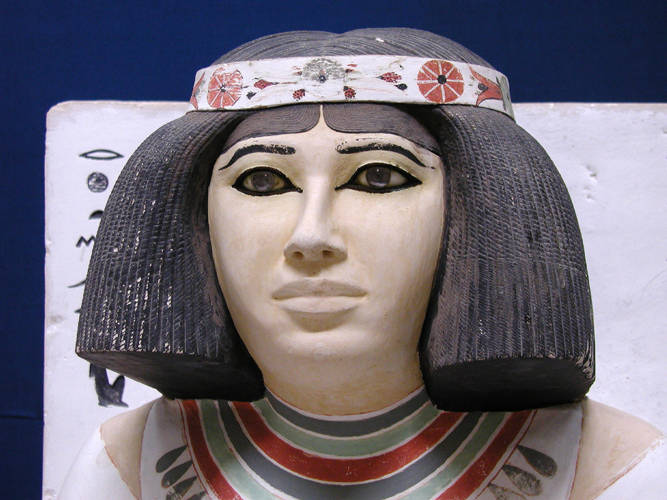
Another son of Sneferu and half-brother of Khufu is Rahotep, who was the High Priest of Re at Heliopolis.  He was married to a lady of unknown parentage called Nofret and they were buried in a mastaba tomb in Meidum. There is a very beautiful and lifelike painted statue of this couple in the museum in Cairo that was excavated from their mastaba. There are also sons and daughters of Sneferu that we still know relatively little about. Ranefer is known from his mastaba at Meidum. Kanefer held the titles of Vizier, High Priest and Overseer of the Troops. His tomb is situated in Dashur, which could indicate that he died after Rahotep and Nefermaat who were buried at Meidum, as during his reign Sneferu abandoned Meidum as a his possible burial place and started building pyramids at Dashur. It is also more than likely that they all predeceased their half-brother Khufu who went on to become the next pharaoh.


Nofret Statue
Nofret Statue

There is also another known son of Sneferu called Iynefer, about whom almost nothing is known and, of course, in the future the sands of Egypt may give up evidence of the existence of further members of this talented, powerful family. There are also some other daughters of Sneferu who we know a little about, such as Nefertkau who may have been married to her half brother Khufu.  She was the mother of Nefermaat II and was buried at Giza during the reign of the pharaoh Khafre. There was also a daughter called Nefertnesu whom very little is known about other than the fact that she had a son called Kaemqued.


So you are beginning to get the picture of how everything was very much all kept within the family, so that political power, military power, administrative power and religious power were all led and directed by members of the royal family for the benefit and prestige of pharaoh and the royal family?  It is perhaps unfortunate that all we know about this dynamic, powerful family comes from the formal inscriptions they have left behind on their tombs and monuments and that we can only guess at the politics, relationships and emotions that were generated between the various members of the royal family.

We can only conjecture that the royal ladies manoeuvred and plotted to get their sons ahead in the succession and high in pharaoh’s favour and we have no idea of how the royal princesses felt when they were married to their half-brothers. Was it a peaceful happy family living in accord or a turbulent, feuding one?  We will probably never know, but we can still go and see the amazing pyramid that Khufu built on the Giza plateau and those of his descendants Khafre and Menkaure and be bowled over by the accomplishments of this ancient family of overachievers.

Nofret Statue Wikimedia Commons any purpose

Saturday, 16 March 2013

Writer’s Block? Call on the Ancient Gods of Writing for Help


All of us writers have our days, or even weeks, when we feel like we are blocked. There are times when the words that usually flow so easily from our typing fingers are harder to find than gold nuggets on the bed of a fast flowing river.  So what can be done to release that writer’s block and get your creativity going again?  Well, if you have tried all the writing tips that you can now find out there on the internet and literally nothing is working for you, then maybe it is time to intercede with one of the ancient gods of writing and writers.

We tend to forget that it is only very recently that being able to read is regarded as a necessary skill that is taught to nearly all children from a young age.  In ancient times, writing was considered sacred.  The only people who could read and write were generally the priests who wrote and needed to interpret the sacred texts, perhaps the rulers and some members or the nobility and the scribes who ran the royal administration.


Thoth - Egyptian God of Writing - Medinet Habu


The Aten Sequence Books are set in Ancient Egypt where from pre-dynastic times they used a form of writing that we now call hieroglyphs.  This is a form of writing that consists of images, phonetic glyphs and determinatives that was used to carve the sacred texts on the walls of the temples, tombs and papyri.  The god that the Ancient Egyptians revered as the inventor of writing was Thoth, who was often depicted with the body of a man and the head of an ibis.  He is also frequently portrayed as an ibis or an ape, or sometimes as an ape with the face of a dog.  Thoth is a lunar deity, so is shown wearing the lunar disc and crescent on his head.  As well as inventing writing, he was credited with inventing medicine, astronomy and geometry. He counted the stars, charted the earth and was the guardian of all wisdom and recorder of all knowledge.   He was also seen as a psychopomp, as when Ancient Egyptians died they believed that they would meet Thoth in the Hall of Maat, where he would record the results of the weighing of their heart against the feather of Maat that determined whether or not they had lived a righteous life.


Uniquely in the ancient world however, during Ancient Egypt’s New Kingdom we do have a source of texts written by ordinary people.  The inhabitants of the workmen’s village at Deir el-Medina were literate as they were responsible for digging out and carving or painting the tombs of the pharaohs in the Valley of the Kings and decorating the walls of their mortuary temples.  The villagers would use flakes of limestone called ostraca and scraps of papyrus to record lists, keep accounts, send letters to friends and loved ones and generally record the gossip of the day.  Egyptologists have gleaned a great deal of information about the lives of these workmen and their families from these writings and it is perhaps the earliest instance where we can follow the goings on and lives of ordinary folk.

The centre of Thoth’s cult was at Hermopolis and during the late period of Ancient Egyptian history when the country was ruled by the Greek Ptolemy’s, Thoth became identified with the Greek god of writing Hermes and was worshipped as Hermes Trismegistus.  Hermes Trismegistus was known as the ‘thrice great’ and was associated with astrology and alchemy.  He is credited with writing philosophical or occult texts such as the Corpus Hermeticum and the Asclepius that are collectively known as Hermetica.  These texts enjoyed a revival in Europe during the Middle Ages and the Renaissance with the alchemists that were studying the occult, magic and also experimenting in turning base metals into gold.


Hermes Trismegistus
Hermes Trismegistus

Perhaps one of the oldest deities associated with writers and writing, who is still worshipped by millions today, is the elephant-headed Hindu god Ganesha.  His mother was the goddess Parvati who created her divine son by smearing her body with a paste made from herbs and sandalwood. She scraped this paste off her body, moulded it into the shape of a young boy and breathed her creation into life. Parvati then went to bathe and asked her new son to keep watch over the house.  While she was bathing, her husband the Lord Shiva returned home and fell into a rage when he was denied entry to his own home by an unknown boy.  His outrage was so great that he struck the boy’s head clean off his shoulders. When Parvati emerged from her bath she was grief stricken when she found out what had happened to her beloved child.  Such was her distress that Lord Shiva sent his retinue out to seek a new head for the body.


The first creature they came upon was an elephant, so they decapitated the animal and brought the head back to Lord Shiva, who then revived the boy by placing the head on his shoulders. But Parvati was still not consoled as she feared that Ganesha would be laughed at and disrespected by gods and mortals alike because of his elephant features. To appease his wife, Lord Shiva blessed Ganesha by proclaiming him to be the ‘Remover of Obstacles’ and that henceforth if you wanted success you had to offer up a prayer to the elephant-headed deity before starting projects and quests.

He is regarded as a deity that presides over writing and protects writers because he broke one of his own tusks, which he is portrayed as holding in his lower left hand, in order to inscribe the epic Mahabharata that was dictated to him by the sage Ved Vyasa.  He is worshipped as the god of knowledge, education, wisdom and prosperity and is depicted as a large-bellied man with the features, huge ears and curving trunk of an elephant seated on a rat.  His elephant head symbolises the soul and his human body our earthly incarnation and he pushes humanity to success by removing our obstacles.


Ganesha
Ganesha
So if you are having trouble with your latest writing project, why not ask for some help or a little push from one of these ancient deities?  Ritual and ceremony have long been used for personal growth and to help move our lives forward, so why not keep a picture or a small statue of your favourite writing deity on your desk to remind you to invoke their aid and tap into the ancient wisdom.  In some ways writing is alchemy, as writers take words and form them into different shapes and meanings, so perhaps it is not so surprising that words and writing were once regarded as sacred? And after all, who of us wouldn’t like a little help in achieving success?


Thoth at Medinet Habu - Own Image Hermes Trismegistus image Wikimedia Commons Public Domain Ganesha Image Khushi Wikimedia Creative Commons Attribution Share Alike 2.0 Generic

Wednesday, 27 February 2013

Ancient Egypt – The Workman’s Village at Deir el-Medina


The second book in the series ‘Hall of the Golden Crocodiles – The Aten Sequence 2’ will be available to download in the spring of 2013.   In it we find that Aten is getting more and more desperate to get hold of the gold he needs so, partly to get his hands on some of the precious metal and partly to irritate his nemesis Neferhotep, he turns to a little light tomb robbing.  

Not known for getting his own hands dirty, he gets Piy to recruit some local tomb robbers from the workman’s village at Deir el-Medina to help him out. The tomb robbers will soon find that they have gotten themselves involved in something a lot stranger and even more terrifying than tunnelling into a sealed tomb in the dead of night right under the noses of the necropolis guards.  But what was the real village they lived in really like and what kind of life would these ordinary ancient Egyptian men have led?

Deir el-Medina - own image
Deir el-Medina

Deir el-Medina


Many of us find the history of Ancient Egypt fascinating with its fabulous golden treasures, pyramids, magnificent temples, pharaohs and gods with the heads of animals and birds. But how much do you know about the lives of the ordinary Ancient Egyptians? Luckily, unlike many ancient cultures, a great deal is known about the daily lives of the workers and their families of ancient Egypt, and much of this knowledge comes from a very unique site called Deir el-Medina. 

The name means ‘monastery of the city’ in Arabic, but to the Ancient Egyptians it was known as ‘Pa-demi’ which means ‘the town’ and also ‘Set-Maat’, the place of truth.  So what is this very important and unique archaeological site? Well Deir el-Medina is the remains of the village where the workmen who worked on the royal tombs in the Valley of the Kings and the Valley of the Queens lived with their wives and children. These highly skilled craftsmen dedicated their whole lives to carving and decorating the tombs of the great pharaohs, and, contrary to what a lot of people believe, they were free citizens and not slaves.

Discovery and Excavation of Deir el-Medina


The village is situated in an arid, desiccated little curve in the hills on the west bank of the River Nile at Thebes, which is now modern-day Luxor.  Like many ancient sites and monuments, the village had become lost in the sands of time. There were several finds of artefacts and papyri discovered in the general vicinity of the workmen’s village during the 19th century, but the first major excavations of the area were undertaken by Ernesto Schiaparelli in the years 1905-1909, during which he discovered large amounts of ostraca, which are large flakes of limestone that were used for writing on.

It is these ostraca that have given us such a vivid picture of the lives of these ordinary people during the New Kingdom of Ancient Egypt, as they contained notes, lists, and private letters that cover everything from official business to complaints and local gossip. A French team led by Bernard Bruyère took over in 1922 and worked on excavating the whole site until 1951, and uncovered the village with its adjacent cemetery and dumps. 

They uncovered a village of worker’s dwellings that opened out onto one main thoroughfare that cut through the middle of the town, with several smaller streets that had been added on as the town had grown. Deir el-Medina was a walled village, with the main entrance being to the north, and the well that provided the village with water was just outside the main gate. The well was not fed by a water source, but had to be filled every day by water carriers who hauled the precious water all the way from the Nile.


Deir el-Medina - own image
Deir el-Medina

The Houses of Deir el-Medina


The dwellings at Deir el-Medina are simple constructions, and the very first houses were made of mud brick and were built without foundations.  The houses evolved over time and they generally had rubble foundations and four rooms with a brick or stone basement. The houses in this ancient village had an entrance hall, a living room with raised mud-brick platforms for seating and sleeping, maybe a couple of small rooms leading off the living area for storage or for use as sleeping quarters for the women folk, and a small open courtyard for cooking and grinding grain in order to bake bread. 

Some of the houses were decorated with frescos of the gods, and many had niches for stela, statues or offering tables. There were even some child burials found underneath the floors. Deir el-Medina is probably the best preserved ancient settlement in Egypt dating from pharaonic times, and provides a fascinating insight into the daily lives of this unique community.


History of Deir el-Medina


The village first came into being during the 18th dynasty, probably during the reign of Amenhotep I, although the first dated remains to have been found come from the reign of Thutmosis I. Amenhotep came to the throne of Egypt as a young child and his mother Queen Ahmose-Nefertari was his co-regent until he was old enough to rule on his own. 

This royal pair was adopted as the patrons of the worker’s village and after their death they then became the village deities, and there is a temple dedicated to them in the vicinity of the village that stands on the terrace above the much later Ptolemaic temple.  There were many feast days during the year in which Amenhotep I’s statue, in his guise of ‘Lord of the Village’ was paraded through the streets, and their joint royal cult was known to be in existence until the late Ramesside period. 

The community was formed from the workmen and their families. They were highly skilled artisans who were better paid and more highly educated than many other ordinary ancient Egyptians. It is likely that even some of the women were literate, as they were known to have received and been sent messages, as for much of the time only the women would have been at home in Deir el-Medina, as their men folk worked long hours in the Valley of the Kings and sometimes were away overnight.

There were generally around 100 people living at Deir el-Medina, and the workmen were divided into two gangs, the Left Side and the Right Side. These two gangs worked under the supervision of two foremen, and all the work undertaken by the gangs was under the administration of the vizier at the court of the pharaoh. The gangs were made up of stone masons, draughtsmen, carpenters and sculptors and would work for many years cutting out just one royal tomb from the cliffs and then executing the intricate wall paintings or fine carvings. Money was unknown in ancient Egypt, so the workers were paid with grain for grinding into flour and barley for making beer, along with pottery, fish, vegetables and wood for the cooking fires. 

There were also scribes who kept records of the progress of the work on the royal tomb, payments to the workers and any supplies that were distributed. It was these scribes and the foremen who acted as the heads of the village, and they were responsible for running the local courts, distributing the worker’s wages and obtaining supplies for the work on the tombs from the royal storehouses. They were also responsible for filling any vacancies in the workforce, and there is evidence that bribes were used to obtain a job in this select enclave of elite royal workers. 

These were prized jobs in Ancient Egypt, and they were passed down from father to son. The working week for these ancient workmen was eight days long, followed by two days holidays.  There were also festival days to be enjoyed during the year and the records show that time was also taken off for illness, and also hangovers and for settling family rows. In their time off the workmen produced superb funerary equipment to supplement their incomes and also dug out their own rock tombs and decorated them with some of the finest tomb paintings known from ancient Egypt.


Deir el-Medina - own image
Deir el-Medina


As long as the pharaoh’s were having tombs cut in the Valley of the Kings, the village thrived, but towards the end of the New Kingdom the Egyptian Empire became under threat from foreign invaders which led to economic instability and a scarcity of food and goods. The inhabitants of Deir el-Medina were totally dependent on receiving their payments of food from the outside, and when the delivery of these supplies started to become irregular they became restless. 

Towards the end of the reign of Ramesses III, they downed tools in exasperation and staged perhaps the first strike in history. They wrote to the vizier stating their grievances and protesting that they were hungry, and refused to return to work. The royal authorities addressed their concerns and resumed their supplies of rations, but other strikes were to follow. Things became gradually more unsettled at Deir el-Medina, with disruptions to the grain supplies and strikes becoming commonplace, and raiders from Libya threatening the area around Thebes.  

It was around this time that tomb robbing became a pastime for the inhabitants of Deir el-Medina, and gangs were formed that would tunnel into the pharaoh’s tombs to loot the gold and rich funerary equipment that they knew had been placed there to aid the pharaoh’s journey into the afterlife. Even the officials were implicated and although there were arrests, torture and executions, the looting continued and it seemed that the Egyptian authorities were powerless to completely stop the gangs. Thebes itself was plunged into civil war and the workers left Deir el-Medina to take sanctuary in the temple of Medinet Habu, but even there they were not safe and the temple was overrun and the unfortunate workers and their families were captured and enslaved.


Eventually, in a frantic attempt to protect the mummies and funerary goods of the pharaohs and their queens, the High Priests of Amun, who were by now the effective rulers of Egypt, emptied the tombs in the Valley of the Kings and the Valley of the Queens of their precious contents and created two royal caches were they hoped that their rulers could rest in peace for the rest of eternity. The days of the skilled craftsmen carving royal tombs and living at Deir el-Medina were over, and the future pharaohs of ancient Egypt would be buried much further north in the Delta.  

The Valley of the Kings would receive no further royal burials and the village was abandoned forever. The last ancient Egyptians to live in the vicinity of Deir el-Medina would have been the priests who served the temple of Hathor that was built during the Ptolemaic period and by then the story of the lives of these remarkable workmen and their families would have already been a very dim and distant memory.

Sunday, 10 February 2013

Before Aten there was ......... ‘Ghosts and Other Really Big Surprises’


Pharaoh’s Gold – The Aten Sequence 1 took a long time to write and edit, so during that time I also started writing articles on the web and short stories.  I was keen to dip my toes into the indie publishing water before I released Aten and his friends out into the big wide world, so I compiled the short stories into an ebook and called it ‘Ghosts and Other Really Big Surprises’.

'Ghosts and Other Really Big Surprises' Book Cover


The book title is a bit of a give away  so it is perhaps not surprising (no pun intended!) that these are spooky tales of ghosts, the supernatural, unexpected events and hard choices that need to be made. After all, how do we know that what we perceive as reality is really the truth?  There are so many layers to our world, so many shadowy corners where anything could be lurking and all is possible.

In 'Best In Show' elderly Harold has been gardening and growing prize winning vegetables for many years.  So he is confused and a little bit angry that his cucumbers aren't growing as big as the neighbours and he is scared that he won't win the trophy at the local fete. So should he try the new 'wonder' fertiliser being sold at the market?

'A Beer at the Consulate' follows the adventures of the two young Egyptologists Rupe and Wilf as they uncover sinister goings on at their dig in the ancient Theban necropolis. They start asking questions, wondering if what the team is searching for should be left undisturbed. Disturbing events lead to chaos in the camp, threatening to allow an ancient evil to escape into the outside world.


'Eloise' is a heart warming Christmas ghost story for children. When two young Victorian children move into the big old stately home, they soon notice that their new home is haunted by another child, one who is long dead. But why does she haunt them and what is she trying to tell them?

'Consolamentum' is a story of the last days of the siege of Montségur, when the beleaguered Cathars were preparing to surrender and had hard choices to make. They could either choose their freedom or to lose their lives in the flames. So will one young girl choose the life that she is yearning to live to the full or follow her beliefs? 

'Mam Says' is a bleak post apocalyptic story set in a Britain that has been swept by a disfiguring new disease that also destroys victim’s humanity. The economy and social order are in total disarray as the authorities struggle to prevent the contagion spreading.  One family struggles on in a run down northern bar, a place where it is wise to listen to what Mam says.

What would you do if you were haunted by a vengeful dead lover?  'The Scent of Roses' is the tragic and romantic story of a young bridegroom who betrayed his marriage on his honeymoon journey through Europe. So now that his young son is ill with scarlet fever, will his spurned lover be able to gain her revenge from beyond the grave?

Have you ever been fixed up with a date by a friend? 'First Date' is a cautionary tale for all of you who, having been disappointed in love, go for the safe option. You know the guy that has always been lurking in the background that you have always ignored while you hung out for somebody more exciting?  But be very careful if you do accept that date because, after all, how do you know what 'Mr Sensible' really has planned for you?


Hazel is the last girl you would ever think that would enjoy a bird watching weekend, having to dress in wellies and unflattering rain wear   So, not surprisingly, she totally miffed when her best friend lies to her and takes her to a twitcher’s convention in remote country pub. It is soon apparent that it is actually the group leader Robin who is the main attraction for her friend, so as the weekend unfolds will Hazel be able to fight her growing attraction to the charismatic bird watcher and also find out what secrets is Robin hiding?


So why not visit Amazon and download a copy of 'Ghosts and Other Really Big Surprises' today?  Don't worry if you haven't got a Kindle, because you can download a free Kindle app onto your PC or laptop.  Enjoy these spooky tales and make sure that you lock the doors, check in the wardrobe and keep all the lights burning while you read!

Saturday, 26 January 2013

Character Interview - Ronalda Bauxneitner from the Interplanetary Daily Gossip Talks With Druitt


Ronalda Bauxneitner reporting from the Interplanetary Daily Gossip

Modern Gurneh and the Ramesseum - own image
Modern Gurneh and the Ramesseum


“Stulfano, can you adjust the lighting over here?  I think we need to get a better angle, all that linen is just getting in the way?”

“Best we can do Ronalda.  Ready to roll in 3,2,1.....”

“Hi, this is Ronalda Bauxneitner from the Interplanetary Daily Gossip broadcasting from Planet Earth as part of our remote worlds and alien diversity programme. We have come here today as we have received a tip off that a member of the First Families is currently sojourning here.  Does this mean that after millennia in isolation and obscurity that Earth is finally to be opened up to inter dimensional tourism? Or is this an unauthorised visit that is, in fact, a breach of Galactic Protocols?”

“I am currently standing outside a charming rustic villa in Ancient Egypt, where I have been lucky enough to secure an interview with one of the entourage of First Family member Aten, who will hopefully be able to give us the inside scoop on why he is here, the purpose of his visit and whether or not he was given special authorization by his father’s High Council to visit a designated ‘primitive’ world.”

“Ah, here he is now.  Say hello to our millions of viewers Mr Montague.”

(Camera pans on to large bulky figure with its face and head covered by a linen shawl.)

“Druitt, my name is Druitt.”

“Oh, well welcome Mr Druitt Montague.”

“No, no Montague Druitt.”

“Mr Druitt, I am having trouble hearing you.  Do you think that you could take that linen shawl off your face?”

“I would prefer not to Miss Bauxneitner, as I would not like to alarm your viewers.”

“Come, come, I am sure that you are a very handsome man.”

“Well, mother always used to tell me that I had inherited all the looks in the family, but that was before.”

“Before what?”

“Before I met Aten!”

“You are intriguing me?  I have come across many different responses to having met Aten in my time, but having to cover their face afterwards was not one of them?”

“Well it was the spell that went wrong.....then not changing me back...Oh I’m not sure I should be telling you any of this!”

“You can tell me Mr Uittmon. Everything that you say on the Interplanetary Daily Gossip is totally confidential.”

“But I thought you said that you had millions of viewers?”

“Yes, but as they are all at least eighty six light years away they don’t really count do they?  So tell me some more about this spell that went wrong?”

“It’s all a bit embarrassing, so I would rather not.”

“Come, come Mr Montru, we are all friends here. It helps to talk you know.”

“Well, his intentions were good, you know.  He wanted to catch that murderer, but it just all went a bit wrong. Maybe the fog and the police whistles distracted him or something?”

“I am going to take a wild guess that you are not from this time frame?”

“Eer yes, I think. This was in London in 1888. You know London in England?”

“I have just been told through my ear piece that this was in a time period called ‘Victorian, is that correct ?”

“I think so, from things I have read from a later date.  Certainly Queen Victoria was ruling our mighty empire at that time.”

“So what was Aten doing there and how did you meet him?”

“Well we didn’t meet as such; it was just an unfortunate coincidence that I got in the path of that spell.  All very irregular of course, not having been formally introduced or anything. Deuced awkward in fact.  I have never forgiven myself for not being able to say farewell and explain to mother.”

“But you still haven’t told us what Aten was doing in Victorian England and why he is now here in Ancient Egypt?  Where is Aten, by the way?  We would really like to talk with him.”

“Aten is out, paying calls. And I really don’t feel that it my place to disclose his social arrangements to a complete stranger.”

“Well, I think you’ll find that Aten and I go back a long way Mr Montague. I’m sure that he remembers me fondly.”

“Mr Druitt.  My name is Druitt!  I can’t recall him ever having mentioned you. But it is all so strange here, that it might have slipped my memory.”

“But this looks like such a charming old villa. So very quaint!  How does living here differ from your lifestyle in Victorian London?”

“Oh it is dreadful!  You can get none of the little necessities that you need in order to live like a civilised gentleman.  There is no running water, the dust gets everywhere and don’t get me started on the food!  The food is nothing like what I used to enjoy at home.  Mother understood my delicate constitution so perfectly and would have cook prepare just the right kind of little delicacies that my poor stomach could tolerate.  Here all I get is bread, onions and that filthy cloudy stuff that they call beer. Can you imagine what it is like to have to start the day without even a decent cup of tea inside you?  At least when we lived on the ship, the computer would always have a pot of Earl Grey, a lightly coddled egg and two slices of white toast ready for me when I arose.”

“So Mr Montuitt, why has Aten moved you here into the villa and away from the home comforts of the ship? After all, it can’t be particularly comfortable for him either?”

“Druitt, woman!  My name is Montague Druitt. Well he lives in a completely different style to the rest of us you know.  Waited on hand and foot by that Tuy woman, servants to pour water for his baths, all the best foods and wine.”

“You sound a bit bitter there Mr Dr.... oh never mind.  Do you feel that Aten is not treating you well?  Would you like to give us a full exposé?”

“Well, no, I mean, I wouldn’t go that far!”

“So why are you living in the villa exactly?”

“Oh it is all too embarrassing and I don’t think that Aten would be best pleased if I told you anything?”

“Well Mr....., whatever your name is, we have millions of viewers here who are just dying to hear the full story about what Aten is doing on this planet.  Did he get a special dispensation to visit do you know?  Can you show us the certificate?  And why is he staying so long?  Is he putting together a plan to open up Earth to inter dimensional tourism?”

“I don’t know what you are talking about.  It’s nothing like that.  But I don’t feel that it is my place to discuss Aten’s circumstances.”

“Are you scared of him Mr Drumont?”

“No, no of course not.  But he can get very tetchy, you know.”

“Well you seem to be very tense.  Are you feeling tense? You are scared of him aren’t you?”

“Look I don’t have to tell you anything. Please go away.”

“Oh but you do.  When we arrived you signed a full disclosure contract, which includes full access to seeing your face.  Failure to comply can lead to prosecution and nine years hard labour in the titanium mines of Sthundalor. So who are you most frightened of now?”

“You can’t do that?  You never said that all those funny alien squiggles meant that?  You said that it was just a formality, something to satisfy your producers?”

“You should never sign anything without reading it and having it checked out by your own lawyers Mr Monty.  If you had read down a few pages you will have seen that The Interplanetary Daily Gossip is legally obliged to provide you with a translator and a lawyer, but by signing you have waived any rights that you had.  We have translators in over twenty six million languages and dialects you know, quite the most comprehensive translating service in this quadrant of the universe.”

“Does nobody speak English anymore?”

“Quite frankly Mr Monuitt, you are exceedingly lucky that we have a translator that does speak English and who was able to programme my earpiece.  It is not designated a ‘rare, obscure archaic language’ for nothing you know.  Only a handful of scholars in any given millennium choose to major in it.”

“Druitt, the name is Druitt.  If you are going to prosecute me, you can at least get my name right.”

“Come, come Mr Druitt did you say?  Things have taken an unpleasant turn. All you have to do is tell us why Aten is here on planet Earth and show us your face.  Then we will go away and leave you in peace. Promise!”

“You really mean that?”

“Sure and would it help you make your mind if I told you a little secret?  Bread and onions would be regarded as luxury gourmet cuisine in the titanium mines. You would also never see sunlight for nine years and would be working back to back, non-stop shifts.  I hear that they find the whip to be very useful in encouraging lazy workers.  Why you are trembling, are you feeling alright?”

“If I tell you will you promise not to let Aten know that I told?”

“Of course, as I said before, everything you tell us is just between us and my millions of viewers.  But first, let us have a look at your face?  Stulfano, take that cloth away with the long tongs.  You don’t want to be touching it, it looks filthy and in this backwater could even be lousy.”

“I say, that’s a bit rude.  Owww, you’ve got my ear with those things. Please let it go, you are hurting me. I’m going to howl.”

My, my you really don’t look much like a Victorian gentleman, do you?  More like some kind of dog?”

“A basset hound, there I said it, I now have the features of a basset hound.  Good solid breed.  Could have been much worse.”

“So to all our viewers who are just tuning in, we are here on planet Earth interviewing a member of First Family Aten’s entourage, who has just very kindly just exposed his face to us.  Shockingly, this human has the features, fur and claws of some kind of dog.  Should this kind a thing be allowed in a modern galaxy?  Please vote now on the poll that you will see flashing up on your screen.”

“I’m not sure it was allowed exactly.”

“So have you always looked like that Mr Drumont?”

“Of course not, I told you before; people used to think me rather handsome, especially the young ladies I have been told.  Can I please cover up again, this is rather too embarrassing.”

“So Aten got a change spell wrong again?”

“No, yes, I mean....  I mean I’m sure he never meant it to happen. Please give me my shawl back?

“Not until you tell us what Aten is doing here?”

“Oh give me that, stop dangling it just within reach and then jerking it back.  I’m sure that your viewers are not enjoying the sight of my face or my obvious discomfort.”

“I think that you will find that our viewers are a broad-minded crowd. Just tell us what he is doing here and it will all be over.”

“He’s stuck.  There, I told you. He’s stuck!”

“Stuck?  How very curious.  And how exactly did such a prominent member of galaxy society get stuck on a rock like this?”

“I have already told you too much.  Please go away?”

“Just answer this question and I promise that we will leave you in peace.”

“And never come back?”

“Never. We promise.”

“Well if you promise.  He ran out of fuel.  He forgot to fill up at the last inter galactic filling station and so he is stuck here until he can get more fuel.”

“For our viewers just tuning in, this is possibly the scoop of the century.  First Family member Aten has fluffed yet another change spell, leaving this poor human looking like a dog.  Will he finally be censured this time by the High Council?  But most shockingly, he is here on Earth because he is stuck.  That’s right folks, you heard it here first.  The great Aten is stuck on Earth.”

“Oh I say, that’s a bit harsh.”

“We now have to be moving on  to our next segment, bringing you the interplanetary gossip that you crave every minute of every day. But before I go I would like to thank Mr Drutly for his kind co-operation and for giving us this amazing scoop.  How will the news that Aten is stuck go down on his home planet?  Stay tuned as I try and track down a family member to interview. And as a gesture of our appreciation Mr Truitgue, I would like to give you this complimentary flask of fuel.  I think that you will find that it is just enough to get you some hot water to bathe in and make yourself a cup of tea.  You will really have to improve hygiene around here if you want to pull the tourists in you know, people expect decent amenities these days.  You can’t just rely on the back to primitive crowd to turn a profit.  Stulfano, get us out of here.

(Low sobs coming from Druitt can be heard and then the rattle of chariot wheels turning into the courtyard.)

“Druitt, why are you standing out in the sun like an idiot?  Are you crying?  And what’s that you’re holding?”

“It’s a complimentary flask of ship’s fuel.”

“Where the devil did you get that?”

“Some reporter, Ronalda something or other from the Interplanetary Daily Gossip gave it to me.”

“Ronalda Bauxneitner was here?  What did you tell her?  How did she know I was here?”

“I told here as little as I could, but she threatened me.”

“She beat you or hold your paws over hot coals?”

“No, no she threatened to prosecute me and send me to some titanium mines where they wouldn’t feed me for years.”

“And you believed her?”

“Well she said it was in the thing she made me sign.”

“Give me strength. Druitt what did you say?”

“Only that you were stuck and she guessed about the change spell when she saw my face.”

“You told Ronalda Bauxneitner that I was stuck?  You told Ronalda Bauxneitner that I got the change spell wrong?  So the whole universe including Uncle Lucie and my father now know I’m stuck on this sorry planet with a loser like you? How do you think that makes me look? And did another teensy little thing not occur to you?”

“Like what?”

“Like that to get here she would have had to have come in a ship that had fuel in it? Those roving reporter vessels never carry less than five spare canisters. If you had had the sense to keep her here until I got back, we could all be on our way home by now?”

“But I thought that you just would have wanted her to be gone as soon as possible.”

“Please don’t think Druitt, just do as you are told occasionally.  Give me that flask before you do something stupid with it.  Do I have to do everything around here?  What have I done to deserve being stuck here with a bunch of losers like you?”

“But she said that I could use the fuel to heat water for a bath.”

“In your dreams, Druitt I have much better uses for this!”


Get Facebook Buttons


Get Twitter Buttons


You can follow Aten and Druitt’s adventures in Pharaoh's Gold - Aten Sequence 1.  You can get it on Amazon:  http://amzn.to/13GNgPF or from the itunes bookstore, Sony, Kobo, Barnes&Noble, Copia, eBookPie, Gardener’s and eSentral. You don't even need a Kindle because you can download an app for free from Amazon.

Wednesday, 23 January 2013

Nefertiti – Where Did She Come From and Where Did She Go?


When Aten gets stuck on Earth, he goes to Ancient Egypt at the beginning of the Amarna period so that he can steal the gold kept in the vaults of the great temple of Amen at Karnak. He manages to drag most of the Egyptian royal family into his adventures and this includes possibly the most beautiful queen to ever reign in Egypt, Nefertiti.  Although in the Aten Sequence books Nefertiti’s exploits are all fictional, there is a real mystery surrounding the historical queen as her origins are shadowy and we don’t know how or when she died. So who was this charismatic, glamorous Egyptian queen, whose name was ‘a beautiful woman has come’?  Where did she come from and what happened to her?

Queen Nefertiti - Berlin Museum
Queen Nefertiti


There are many theories about the origins of Nefertiti.  She is first documented historically after the accession to the throne of her husband Amenophis IV, who later became known as Akhenaten.  She was his Great Royal Wife, and unlike earlier Egyptian consorts, who were shadowy figures, was depicted on temple and tomb walls and in statuary in equal size to her husband.  She is also shown engaging in some unusual activities for a queen, such as driving her own chariot and even smiting the enemies of Egypt, imagery that is normally reserved for kings.  The precedent had been set in the earlier reign of her husband’s father Amenophis III, when his Great Royal Wife Tiye was given prominence on many of his monuments. Also unusual in Egyptian art, were the images of the royal couple kissing and embracing and showing affection to their daughters.  Either they really were a devoted couple in love; or that putting emphasis on or depicting the love and closeness of the royal family was important in some way to the new cult of the Aten.

It is very unlikely that Nefertiti was a daughter of Amenophis III, as her titles do not include ‘King’s Daughter’, ‘King’s Daughter Whom He Loves’ or ‘King’s Daughter of His Body’.  She is referred to as ‘Heiress’, ‘Lady of the Two Lands’, ‘Mistress of Upper and Lower Egypt’ and ‘Great Royal Wife’, but none of these titles imply in any way that she came from a royal background.

It has been postulated that Nefertiti was a foreign princess; sent from the court of either the Hittites or the Mitanni to be married to pharaoh and cement alliances between the two countries.  However, there is no evidence to either support this or refute it.   Several princesses from foreign courts are on record as arriving in the harem of Amenophis III.  Tadukhipa, the daughter of Tushratta King of Mitanni arrived at court in Year 36, and has been identified both with Nefertiti and a lesser wife of Akhenaten called Kiya.

If Nefertiti was, indeed, of Egyptian descent; then who were her parents?  Her only known relative is her sister, or half-sister, Mutnodjmet, whose name means ‘Sweet One of Mut’.  She is referred to in inscriptions in tombs at Amarna as ‘sister of the King’s Great Wife, Neferneferuaten-Nefertiti’ and is often portrayed with the elder three of Nefertiti’s own daughters. Mutnodjmet is also frequently depicted being accompanied by two dwarfs.  She is believed to have been a daughter of Ay and Tey, as she features prominently in their tomb at Amarna
.
Ay was a prominent courtier of Akhenaten’s, holding the title ‘Overseer of All the Horses of His Majesty’.  He is thought to have been the son of Yuya and Thuya,who originated from the regional town of Akhmin, therefore making him a brother to Tiye, the Great Royal Wife of Amenophis III.  Therefore, if Ay was also the father of Nefertiti, this would explain how she was close enough to the Royal Family to marry one of the princes.  However, there is no indication that Ay’s wife Tey was Nefertiti’s birth mother, as nowhere does she claim the title of Queen’s mother, only that of nurse.  Neither does Ay claim the title of ‘Queen’s Father’; but he did claim the title ‘God’s Father’ which had been held by his father Yuya before him.  Yuya was a fairly uncommon name in Ancient Egypt, which has led to a belief that he, too, was of foreign origin.


Nefertiti was influential in Akhenaten’s breaking away from the old god’s of Egypt and the adopting of the worship of the Aten.  By year 5, Amenophis IV had changed his name to Akhenaten and by Year 7 the royal couple with their daughters had moved to the new capital they had built at Akhetaten, modern day Amarna.  The couple had six daughters, Meritaten, Meketaten, Ankhesenpaaten, Neferneferuaten, Neferneferure and Setepenre.  There is no evidence that they had any sons; but Amenophis III in the previous reign had never mentioned any of his sons on his monuments, so there could have been princes that we have no evidence for.  Amenophis III also paved the way to the prominence of the Amarna princesses on their father’s monuments, as he portrayed his daughter’s with their names and titles on his statues and temples.  Indeed, several of them were also given the title ‘King’s Wife’, indicating that they were married to their father, although we do not know whether these marriages were actual or purely symbolic.

The cracks seem to have started appearing at Akhetaten around Year 12.  Princess Meketaten appears to have died at that time.  There are theories that she died in childbirth, or that she died of a plague that was sweeping through the Middle East during this period.  The two younger princesses’, Neferneferure and Setepenre also seem to disappear from the records around that time, also possibly victims of the plague.

Nefertiti herself disappears from history around Year 14 of her husband’s reign.  The question is did she die, did she fall from grace in some way, or did she change her name and rule briefly as co-regent and as pharaoh after her husband’s death?  There are no historical records of her death and there is no evidence of her being buried in the royal tomb at Amarna, although some jewellery bearing her cartouche was discovered outside.

Royal Chariot at Amarna

 
In the tomb of Amenophis II in the Valley of the Kings, three mummies were found in a side chamber.  One of these, known as the ‘Younger Woman’ was put forward as being the mummy of Nefertiti.  The style of mummification points to the late 18th dynasty, there was a distinctive wig in the ‘Nubian’ style known to be worn by Nefertiti found nearby, the mummy has double piercing in her ears as Nefertiti is depicted as having, the lower half of the face is mutilated, and a snapped off arm in the bent position reserved for royal women of the period was believed to have belonged to the body.  However, other women of the royal court are depicted wearing similar wigs and with double pierced ears.  It was believed that the mutilation of the face was a deliberate act to destroy the identity of the mummy after embalming had taken place, as an act of vengeance against the wife of the ‘heretic’ king.


However, it has been argued that if the wound had been inflicted post-embalming there would be fragments of bone and dried flesh in it.  Indeed, it was pointed out that there were very few pieces of the relevant bones found in the sinus cavity and therefore it was most likely that the wound was inflicted before death.  It was also found that the bent arm did not actually belong to the mummy; but it was rather a straight arm also found in the vicinity that was the correct one.  However, when the DNA of the ‘Younger Woman’ mummy was analysed during the ‘Tutankhamun Family Project’ in 2010, it was shown that this royal lady was, in fact, one of the daughters of Amenophis III and Queen Tiye and the mother of the famous boy king Tutankhamun. Which daughter is not certain, but although Amenophis III married several of his daughters, there is no evidence that he married either Nebetah or Baketaten, so they could have married their brother and given birth to Tutankhamun.

So the mummy of the beautiful Queen Nefertiti has still not been found. Positively identifying her remains may have given us valuable evidence about how she was related to the royal family, her health during her life and, possibly. give us the cause of her death.  So what was her eventual fate?  The ‘fall from grace’ theory comes from the fact that some cartouches and titles of Nefertiti were thought to have been removed from monuments and replaced by those of her daughter Meritaten’s.  It is now believed, however, that it was one of Akhenaten’s other queens, Kiya, whose name and titles were replaced.

Nefertiti as an older woman


The theory that seems to be gaining popularity is the one that Nefertiti lived on for several years under a different name, either as a Co-Regent with Akhenaten or as pharaoh on her own.  It is believed by some that she first changed her name to Ankhkheperure Neferneferuaten as Co-regent and then to Ankhkheperure Smenkhare, as she ruled briefly alone.  Some of the evidence for this comes from the Co-Regency Stela in the Petrie Museum in London, which depicts Akhenaten, Nefertiti and Meritaten.  At some time later Nefertiti’s name was chiselled out and replaced with Ankhkheperure Neferneferuaten, and Meritaten’s replaced with that of her sister Ankhesenpaaten.  The two names have also been associated with the ephemeral pharaoh Smenkhare, who is thought to have ruled for approximately three years after the death of Akhenaten, and who was believed to be married to the royal couple’s eldest daughter Meritaten.  It has been suggested that Nefertiti assumed the crown as Smenkhare, and that Meritaten acted as her queen consort after the death of Akhenaten.


It may be that we will never really know what happened in those shadowy years at the court at Akhetaten.  Is the truth still buried under the shifting sands of Egypt, or has all the evidence been lost forever?  There is undoubtedly a lot still to be found, and new discoveries, such as the new tomb KV 63 in the Valley of the Kings, will hopefully fill in some of the missing details of the this fascinating period in Egypt’s ancient past.


Get Facebook Buttons


Get Twitter Buttons


Queen Nefertiti image Wikimedia Commons Public Domain
Older Nefertiti image Wikimedia Commons Public Domain
Amarna Chariot Image Kurohito Wikimedia Creative Commons Attribution Share Alike 3.0 Unported