Showing posts with label Egyptian pharaohs. Show all posts

Wednesday, 5 February 2014

Are There Any More Undiscovered Royal Tombs in The Valley of the Kings?


Aten wants gold, more gold and more gold.  And then he has to work out how to make the fuel he desperately needs so he can get back to conquering the Universe with his Uncle Lucie.  While he tries to work out how to get into the massive treasure vaults beneath Karnak Temple, he sets up a little tomb robbing ring.  Aten’s goal is to find intact royals tombs brimming with gold treasure.  Finding an intact royal tomb in the Valley of the Kings is also the dream of many Egyptologists today.  But was the tomb of the boy king Tutankhamen the last big discovery that the Valley of the Kings will yield or are there more amazing finds just waiting to be unearthed?

The discovery of the tomb of a minor pharaoh from the end of the 18th dynasty in 1922 by Howard Carter and Lord Carnarvon rocked the world.  Never before had an almost intact pharaoh’s tomb been found in the Valley of the Kings, and this discovery gave us not only fabulous treasures but a great deal of valuable information on the end of the Amarna period. But is the boy king’s tomb the last great discovery to be made in the Royal Necropolis or are there more undisturbed tombs hidden in the cliffs and valley floor waiting to be found?

Valley of the Kings Excavations
Excavation in the Valley of the Kings - November 2008


That there are many tombs yet to be unearthed in Egypt has been amply demonstrated over the last few weeks.  In Abydos, the sacred heart of Ancient Egypt, a huge quartzite sarcophagus discovered a year ago has been identified as belonging to an obscure pharaoh of the 13th dynasty called Sobekhotep I,  leading to the discovery close by of the tomb of a previously unknown king.  Hieroglyphs painted on the tomb walls gave his name as Senebkay.  And just around the corner from the Valley of the Kings at el-Khokha, a beautifully painted tomb of a courtier from the Ramesside Period is being excavated.  The tomb belonged to the Chief Brewer of the Temple of Mut called Khonsu-em-heb and the exquisitely painted frescos show him and his wife Mutemheb feasting and making offerings to the gods. So could there possibly be more royal tombs waiting to be found in the Valley of the Kings?


The first burial in the arid, remote valley was a departure from tradition.  In earlier dynasties, pharaoh’s tombs had been built in plain sight as a sign of their power and prestige.  From the earliest mastaba tombs to the pyramids, these tombs were as large and lavish as the pharaoh’s treasury and length of his reign allowed.  Even as late as the 17th dynasty, pharaohs were buried in small pyramids at Dra’ Abu el-Naga, a necropolis in the Theban hills. So why did a high court official called Ineni dig a rock cut tomb for his royal master, boasting ‘alone, no one seeing and no one hearing’?  Possibly because it was becoming obvious that most of these ostentatious, very visible tombs were being entered by tomb robbers, who stole the precious funerary treasure and ripped the pharaoh’s mummies apart looking for amulets and jewellery.


Valley of the Kings, Luxor, Egypt
Valley of the Kings

But although it might have been possible to conceal the location of one royal tomb, as successive pharaoh’s carried on digging their tombs in the same valley, the site of the royal necropolis became well known and a workmen’s village was built at Deir-el Medina to house the men who dug and decorated these fabulous sepulchres.  To date sixty four tombs have been found in the Royal Valley, belonging to queens, royal children and favoured courtiers as well as the mighty pharaohs themselves.  So who is missing?  Which pharaoh’s tombs have not yet been found?  The two main contenders are Thutmosis II from the early 18th dynasty and Ramesses VIII from the 20th dynasty.  The mummy of Ramesses XI has also not been found and though a tomb was dug for him in the Valley of the Kings, there is no evidence he was actually buried in it. Most of the tombs of the queens from the 18th dynasty have also not yet been located and there may also be smaller tombs of princes, princesses and royal officials still awaiting their turn to be discovered.


In 2007 Dr Zahi Hawass appointed an Egyptian team of archaeologists headed by Afifi Rohiem to start excavating in parts of the Royal Valley where he believed there might be a new tomb.  At the same time the Glen Dash Foundation for Archaeological Research undertook thorough ground-penetrating radar investigations of the cliffs and valley floor.  The Egyptologists worked between 2007 and 2010, starting with the area around the tomb of Merenptah.  Their excavations rediscovered some ancient graffiti first recorded by Jaroslav Czerny and the remains of some workmen’s huts, which have been carefully recorded.  Tantalisingly, one of the ancient graffito was written by an official called Userhat who said that he had created a burial for his father close by.


The Egyptian found two cuttings in the rock that could be tomb entrances, one where the rubble has been disturbed, suggesting that whatever is there has already been disturbed, and one where it had not. Could this be the entrance to an intact tomb?  These two new tomb entrances became known as KV64 and KV65.  The KV64 entrance was found close to Merenptah’s tomb and is Ramesside in appearance.  It was thought this could possibly be the entrance to the tomb of Pharaoh Ramesses VIII. The other tomb entrance was cut and in the style of the 18th dynasty and Dr Hawass stated in a lecture that he thought this could be the tomb of an individual from the Amarna period and that some debris has been excavated that had the name of a previously unknown queen on it.


However, for some reason no further investigations of these tomb entrances were undertaken, possibly they were halted by the civil unrest that started during 2011. In January 2012 a team from the University of Basel in Switzerland stumbled across a new tomb in the valley completely by chance.  When they opened it they found it contained the undisturbed coffin and beautifully wrapped mummy of a temple singer called Nehmes Bastet dating from the 22nd dynasty. The tomb, now officially designated as KV64, was not originally built for her but had been usurped from an earlier period. The inscriptions show that Nehmes Bastet was the daughter of the High Priest of Amun, so are there more burials from this family and period still awaiting discovery in the Valley?


So there is a strong chance there are still some major finds to be made in the Valley of the Kings. KV63 is now thought to have been more of a storage chamber for burials of the Amarna period, rather than a royal tomb.  Most of the burials of the royal ladies of this period have not yet been located and finding the tomb of one of the major figures, such as the iconic beauty Queen Nefertiti, would be very exciting and help to clarify what really happened during this shadowy part of Ancient Egyptian history.  The mystery tomb KV55 could be the tomb of the heretic Pharaoh Akhenaten or his ephemeral successor Smenkhare, so is either of these king’s tombs still concealed in the cliffs somewhere?


Valley of the Kings Luxor - west branch
Western Branch of the Valley of the Kings


We also still do not know the complete family tree of the pharaoh’s or of their court officials, so there could be tombs to be discovered that belonged to queens, royal children, ladies of the harem or nobles we have never before encountered in Egyptian history.  Also all the tombs visited by tourists are in the eastern branch of the Valley of the Kings.  There is a western branch that contains the tombs of Amenophis III and Ay that is rarely visited and has not yet been thoroughly surveyed or excavated. But although a tomb stuffed full of golden treasure would captivate the media and the public the world over, any find, however small, adds to our knowledge of our ancient past and fills in another piece of the puzzle.


Sources: Wikipaedia, BBC News

Sunday, 11 August 2013

The Importance of Gold to the Ancient Egyptians

In The Aten Sequence Books, our hapless main character Aten is desperately trying to get his hands on enough gold to make more fuel for his ship, so that he can blast off back into space and join his evil Uncle Lucie in conquering the Universe.  After trying out a few options, such as the Bank of England in Victorian London, he decides the Temple of Karnak during the reign of the fabulously wealthy Pharaoh Amenophis III is his best bet.  Now this is pure fiction, but the Ancient Egyptians were famous for the amount of gold they possessed, so why was it so important to them?


“And gold – everywhere the glint of gold” - Howard Carter on what he saw as he opened the tomb of Pharaoh Tutankhamun in the Valley of the Kings.


Cobra Details on Tutankhamun's Gold Throne


Most people when they think of Ancient Egypt think of gold.  Ever since the glittering tomb of the boy king Tutankhamun was excavated in 1922, we have associated the mysterious land of Egypt with untold wealth and glittering treasure. It seemed as though every exquisite piece of funerary equipment removed from the tomb was gilded in the precious yellow metal or even made entirely of solid gold, like the famous funerary mask and inner coffin.  And if this was the treasure placed in the tomb of a relatively insignificant pharaoh who only ruled for a few years and died young, what wealth could the tombs of the mighty kings such as Ramesses the Great and Thutmosis III have contained before they were robbed?

But why was gold so important to the Egyptian pharaohs?  It was not a precious metal used by the ordinary people; it was reserved for the exclusive use of royalty and important nobility.  Domestically it had no economic value, as barter was used for trade and all servants of the crown were paid with food, fuel and gifts.  

Money was not used in Egypt until the Ptolemaic period, so gold was not used in coins. One of the reasons it was so highly prized was that it was associated with the dazzling light of the sun and the solar deity Ra.  It was believed that the very skin of the gods was golden and that their bones were composed of silver.  Because it is a precious metal that does not tarnish and is fairly indestructible it was also associated with eternal life.  The pharaoh was viewed as divine, the human link between the earth and the numinous, so gold was used for royal coffins and funerary equipment to help preserve the king’s mortal remains for eternity.


It was in international trade that gold became important, and Egypt became famous for the amount of the prized precious metal that it sent to all corners of its far flung empire.  It was not only used for trade, it was also an important diplomatic tool as pharaohs would send quantities of gold and gilded treasures to their allies and vassal monarchs in order to keep them happy and fighting to maintain Egypt’s borders. 

So used were these vassal kings to having a continuous flow of gold being sent out to them that they would write and complain if there was any disruption in supply.  In the late eighteenth dynasty King Tushratta of Mitanni wrote to Queen Tiye to moan that her husband Amenophis III was only sending gilded statues not the solid gold ones he had apparently promised:
I have asked Mimmuriya, your husband, for massive gold statues.  But your son has gold-plated statues of wood.  As the gold is like dust in the country of your son, why have they been the reason for such pain, that your son should not have given them to me?

Gold was also given as rewards to courtiers and military leaders.  Reliefs at Amarna show the royal couple Akhenaten and Nefertiti handing out golden collars and arm rings to their faithful followers and large flies fashioned from gold were handed out for valour on the battlefield, much as we give out medals today. Interestingly these military awards were sometimes even presented to women, as Queen Aahhotep I, the mother of Pharaoh Ahmose I, was buried with three such flies in her tomb.

As the wealth and might of the Egyptian empire grew in the New Kingdom, so did the prestige of goldsmiths.  The men who created the exquisite jewelry, statues and funerary masks became feted and wealthy in their own right.  They developed several techniques that are still used by jewellers today such as utilising the lost-wax technique to make intricate statues, beating gold into fine leaves, and mixing it with other metals to create alloys.  

Electrum, a blend of gold, silver, copper and other metals, was one such alloy that was very widely used to plate the exterior of monuments such as obelisks and the pyramidions that topped the pyramids.Gold had been mined and worked in Egypt since predynastic times. How it was first discovered is shrouded in mystery, but this very early gold was more than likely extracted from alluvial deposits. 

It was one of the first metals to be worked and used by prehistoric man, probably because it could be found in the natural world that surrounded them, is very malleable and soft so can easily be worked with rudimentary tools, and its shine and glitter would have made it attractive for use in jewelry and ornaments.  Most of the gold extracted in antiquity in Egypt was mined in the Eastern Desert and Nubia. In fact Nubia even incorporates the ancient word for gold ‘nub’ in its name.


  Ay receiving rewards of gold from Akhenaten & Nefertiti
Ay receiving rewards of gold from Akhenaten & Nefertiti

All of the mines in Ancient Egypt were state monopolies and were worked predominantly by prisoners and slaves.  According to the writings of the historian Diodorus Siculus in his Bibliotheca historica written around 60 BCE these unfortunate souls were treated very badly; being made to work in appalling conditions, with little food or water and being beaten if they weren’t thought to be working hard enough.

The methods of extracting the metal were simple but effective. The earliest method used was probably extracting gold from auriferous sand, which was known in antiquity as nub-en-mu or  ’gold of the river’.    Quantities of auriferous sand would be placed into a sack made from an animal fleece, with the woolly side facing inward.  Water would then be poured into the bag and vigorously shaken around by two men.  This would separate the heavier metal from the dirt and grit and when the water was drained out, it would take the dirt with it leaving the gold dust adhering to the fleece.


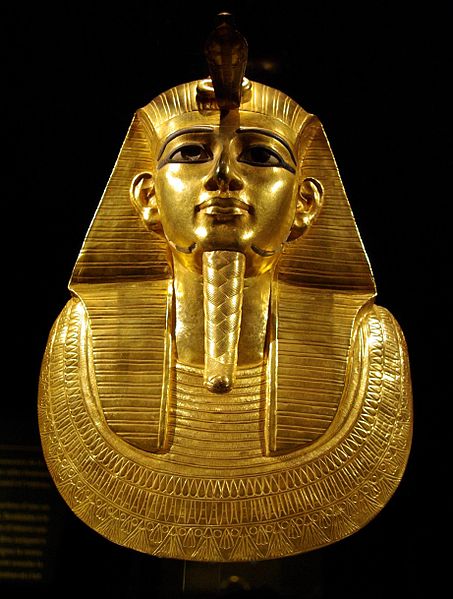
Funerary Mask of Psusennes I
Shallow underground mining probably didn’t start until the New Kingdom and this technique of extraction was known as nub-en-set or ‘gold of the mountain’.  The metal bearing rock was first crushed into powder and then spread over a stone table that was slightly tilted.  Water was then poured over the powder, which separated all the dirt and dust from the metal, leaving only the particles of gold on the table.  

This was repeated a few times until only gleaming, yellow metal particles remained.  They then rubbed these precious particles between their hands for a length of time, before they finally ran small sponges over it to clear out any remaining dirt.


So far there have been over a hundred gold workings and settlements that have been found, most of them in the arid wadis of the Eastern Desert.  However, according to the map on the Turin Papyrus, there were at least 1300 such mines in ancient times.  Hopefully, more evidence and remains of the ancient gold mining industry will be excavated from beneath the sands of Egypt, as well as further beautiful examples of the ancient goldsmith’s art.


Psusennes I image Lazaroni Wikimedia Creative Commons Attribution 2.0 Generic
Ay gold rewards image ddehisen Wikimedia Creative Commons Attribution 2.0 Generic
Gold Cobra image External Radiance Wikimedia Creative Commons Attribution Share-Alike 3.0 Unported