Sunday, 23 June 2013

What Happened to the Three Youngest Amarna Princesses?

The heretic Pharaoh Akhenaten and his beautiful wife Queen Nefertiti had six daughters, who were often shown with them on their monuments and in tomb decorations.  Before this time at the end of the 18th dynasty it was rare for Pharaoh’s to be shown with their offspring or even alongside their royal wives, and there are probably many royal children who have not made it onto the pages of history from Ancient Egypt. But from these illustrations from Amarna it would appear that these little girls lived a privileged life of luxury and ease in the royal palace and also that they were loved and included in both the public and private lives of their parents.  But life expectancy was not very long in Ancient Egypt, even for the cosseted children of royalty, so what did happen to the three youngest Amarna princesses Neferneferuaten Tasherit, Neferneferure and Setepenre?

Amarna Princesses - Neferneferuaten and Neferneferure
Amarna Princesses - Neferneferuaten and Neferneferure


What draws many people to the Amarna period of Ancient Egypt is the innovative, more realistic style of the art and statuary.  For the first time in Ancient Egypt’s long history the palaces were decorated with colourful scenes from nature, such as flying birds, fish in ponds, gambolling calves and plants.  The royal family were also shown in a more natural guise for the first time.  No longer were the Pharaoh and his Great Royal Wife shown in the perfect, formal poses of earlier reigns; they were drawn or carved with pot bellies and long, spindly limbs, doing the kind of things that ordinary families do, such as playing with the children and showing affection to one another. Some of the most charming scenes from this time depict the young Amarna princesses playing with each other, cuddling with their parents or even being naughty by poking a chariot horse with a stick.  But, as well as being attractive images, these carvings and wall paintings provide us with most of the evidence we have regarding the lives of these royal children.

Their royal father Akhenaten abandoned the traditional capital and religion of Egypt and built an entirely new city called Akhetaten, based on the worship of the Aten or sun disk, for his family and to be the principle royal administrative centre.  It is very likely that Neferneferuaten Tasherit (Beauty of the Beauties of Aten’ – Tasherit means ‘the younger one’ or ‘little’) was the first of the royal sisters to have been born in the new city, followed by Neferneferure (‘Most Beautiful One of Re’) shortly after and then the youngest princess, Setepenre (‘Chosen of Re’).  The very first image we have of them all dates to around year 9 and is a wall painting from the King’s House in Amarna. It shows the entire royal family relaxing, with Neferneferuaten Tasherit painted sitting with her sister Neferneferure on a cushion.  The fresco is very badly damaged unfortunately and all that is left of the picture of the youngest daughter, Setepenre, is her tiny hand.

The three youngest Amarna princesses are also shown in the decorations on the walls of the noble’s tombs at Amarna.  It is in these tombs that we see the last scenes that show Nefertiti surrounded by all six of her daughters.  In year 12 of Akhenaten a ‘Great Durbar’ was held at Amarna where foreign rulers and vassals came from all corners of the Empire to pay tribute and give offerings to the Pharaoh.  The three little princesses are shown with their elder sisters standing behind Akhenaten and Nefertiti as they receive tribute in the tombs of Meryre II and Huya, the Chief Steward of their grandmother Queen Tiye, and in one of the registers Neferneferure is shown holding a pet gazelle, which her youngest sister Setepenre leans forward to pet.  This ‘Great Durbar’ seems to be the nadir of Akhenaten’s reign, as after this glittering event things seem to start falling apart at Akhetaten and many members of the royal family slip away into the shadows of history.


There is evidence from the Amarna letters that a great plague was sweeping through the Middle East at that time and that unwittingly the coming together of so many people from different countries could have helped it to spread.  It is thought that the three youngest Amarna princesses may have been victims of whatever disease it was that was ravaging the population of Egypt.  The tiny Setepenre may have been the first to die, as there is no evidence of her after years 13-14.  Her name does appear on Wall C in the Royal Tomb, along with that of four of her sisters. She is also not shown on a wall in another chamber of the tomb that shows her parents and family mourning the death of her older sister Princess Meketaten.  No evidence of her burial has been found, although she was very likely interred in the Royal Tomb and, heartbreakingly, the little girl was probably not even six years old when she died.

Princess Neferneferure is also missing from the death scene of Meketaten in the royal tomb at Amarna, so may also have died by years 13-14.  However, it is important to remember that we do not know that much about the protocol surrounding royal burial ceremonies; these two princesses may simply have been too young to have been mourners in the scene.  However, Neferneferure’s name is plastered over on Wall C in another chamber in the tomb.  She could also have been buried in the Royal Tomb, although there is some evidence she could have been buried in another tomb at Amarna, Tomb 29, based on an inscription that was discovered on the handle of a pot that refers to the ‘inner (burial) chamber of Neferneferure’.  If she was indeed interred in this other tomb, it could be that she died after her father Akhenaten and the Royal Tomb was already sealed and could not be opened for another burial.

Akhenaten, Nefertiti and their daughters
Again we cannot be certain what happened to Neferneferuaten; when she died or what was the cause of her death.  She is shown on the walls of the royal tomb mourning the death of her elder sister Meketaten accompanied by Meritaten and Ankhesenpaaten, so was presumably still alive at this time, which was around year 14.  There has been speculation that Neferneferuaten could have been married to a foreign ruler, one of her father Pharaoh Akhenaten’s vassals, and sent abroad but this has never been proved and would have been highly unusual. Egyptian princesses were married within the royal family or to prominent courtiers, and not married off into foreign royal families as diplomatic bargaining pieces. There is also a theory that she could have been her father’s mysterious co-regent, a shadowy figure who may have been either male or female. However, it is thought that she died before Tutankhamun and her sister Ankhesenpaaten (Ankhesenamun) came to the throne, as there is no evidence of her during their reign that has so far come to light.


Perhaps we will never know what the ultimate fate of these three young Amarna princesses was, but the sands of Egypt still hold many secrets and new evidence may be found during future excavations. So hopefully there are artefacts out there still waiting to be found that might give us more clues and further glimpses into the extraordinary royal lives of these three little girls.


Image Amarna PrincessesNeferneferuaten and Neferneferure Wikimedia Commons Any Purpose
Image Akhenaten, Nefertiti and their daughters Wikimedia Commons Public Domain

Thursday, 6 June 2013

Introducing ‘Hall of the Golden Crocodiles – The Aten Sequence 2’

It always felt a little strange talking about a series of books when there was only one available, but at last there is actually an Aten Sequence!  It feels like it has been a long time coming, but the second book in the series ‘Hall of the Golden Crocodiles – The Aten Sequence 2’ has now been self published and is available as an ebook on Amazon Kindle, ibookstore, Barnes & Noble, Reader Store (Sony), Kobo, Copia, Gardners, Baker & Taylor, eBookPie, eSentral, and Scribd.

The Temple of Karnak


In this second book in the series, we find our immortal friend Aten getting ever more desperate.  He is very close to running out of fuel and, now that the High Priest Neferhotep is even more suspicious of him, it looks like his chances of getting at the gold stored in the vaults beneath the Temple of Karnak are even slimmer. As taking responsibility is not his style, he blames his travelling companions the half man/half basset hound Druitt, the tempestuous Galasian cocktail waitress Tuy and Luke the rebel teenager from the 21st century for all his troubles.

So he sends Luke and Neferptah back to the palace to be educated in the Kap, a military training school for the royal princes and nobles, with Prince Dhutmose and his pals, in the hope that they will be able to find a way into the temple for him. Of course he neglects to tell the boys that’s why they are there and eventually has to blackmail Luke into going in search of the Princess Merytamen, in the hope that she will be able to lead him to his goal.


So once again the two boys find themselves stealing through the palace corridors in the middle of the night, desperately hoping they will not be caught.  But their pursuit of Merytamen sets off a chain of events that eventually leads them deep into the tunnels and halls beneath Karnak, on a dangerous quest to find the princess.  As their friends from the palace try and find them before they are missed and Aten follows them in hot pursuit of the gold, can the two boys survive the dangers that lie before them?

Because there are ancient spells protecting the darkened corridors and vaults of the temple; powerful magic that can only too easily be awakened by unwary trespassers in this most sacred part of Karnak.  There is also the little matter of an irate High Priest, who is a powerful magician in his own right and who would do anything to keep them away from the princess, to contend with.

The Temple of Karnak


Hall of the Golden Crocodiles is a light hearted science fantasy novel suitable for both young adults and older readers, featuring all of your favourite characters from Pharaoh’s Gold. There are also some exciting new characters for you to meet such as the talking royal cat Ta-miu, Prince Amenophis’s creepy new friend Mahu and the tomb robber Parneb.  But it is someone from Aten’s past that causes the biggest surprise; a new arrival that could make his life even more complicated.


So will Aten get the gold he so badly needs and manage to make enough fuel to leave Earth and join his Uncle Lucie at last?  Or will all his plans just fall apart again, leaving him stuck forever?  Whatever happens, you can bet that none of it will be his fault and that there will be plenty of adventures along the way.


Download your copy today to find out!


Authors: What Type of Social Media User Are You?

Being a successful author used to be a lot easier.  You sat in a freezing cold attic with little food, scratched away with your quill pen long into the night, abjuring all human contact in order to follow your muse. And then, after you died in misery and penury, your manuscript would be discovered, become a bestseller and you would be hailed as a genius. Simple.

But now, oh the horror of it, {cue dramatic drum rolls} we indie authors have to do our own marketing!  That’s right, those books don’t sell themselves and as more authors choose to self-publish it becomes even more imperative to make your books stand out from the crowd and be noticed.

Jane Austen - Wikimedia Commons Public Domain
Jane Austen 


Now, as you might have gathered from my earlier post ‘WritingSuccess’, I’m not a great fan of rigidly following other writer’s paths to success and it is important that you find a way of promoting your books or articles that works for you.  It’s more of a buffet approach, where you can read what has worked for others, appreciate the success they have achieved and then pick out the bits that resonate with you.  But there is one thing that is getting increasingly hard to avoid and that is social media.

Now many of us authors are shy, introverted creatures who feel much safer tucked up behind our laptops dunking chocolate digestives in our tea, but if we want our work to be noticed in the big wide world, we have to be brave and dip our toes into the churning ocean that is now social media. ‘Write and they will come’ is a nice idea, but your stories and characters will probably get a bit lonely and your light will remain firmly stuck under the bushel if you don’t get on with choosing your profile picture and writing your blurb.

I know that it can seem daunting and, to be quite honest, you will probably have to develop a thicker skin, as at some stage you will probably encounter a few internet trolls, jealousy or nastiness.  Just let it go and do not respond is probably the best policy.  Some people just cannot help themselves and if you feed a troll they will just keep coming back for more.

Probably the two most important resources that authors use are Facebook and Twitter.  Setting up accounts on both is a straight forward exercise and there is plenty of help on the internet to get you started.  With Facebook you can set up a page as an author or you can set up pages for your individual books, although you will need a personal account in order to do this.  With Twitter, you just set up your account and happily start tweeting.


Now this is not a ‘how to’ article, as there are already thousands of them out there written by experts who know a lot more than I do about the technical stuff.  I just wanted to ask you what type of social media user are you?  What are you hoping to gain by using these tools?  It might seem like a strange question, but many social media newbies can scupper their chances of success and becoming popular, by only focussing on what they can gain.  They view it as a simple marketing exercise and, probably with the very best of intentions, plaster the social media networks with their links and promotions. This is known as spamming and is very much frowned on and can even get your account terminated.

But why is this spammy approach regarded as such a bad thing you may be asking?  Isn’t getting my book links out there what I am giving up some of my precious writing time to do? Well, it is because being overly promotional is simply not how social media works.  The clue is in the word ‘social’.  These tools were set up so that people could socialise and communicate with each other, places where they could build up online communities.  View it more like a real world conference or party.  Would you just go barrelling in there, thrusting your business cards into people’s hands, not even waiting for them to respond before you moved on to the next person? No you would not.  You would take some time to introduce yourself and let others introduce themselves also.  You would chat and establish some common interests and only then, when you have made a connection with the other person, would you give them your contact details or promotional material.  One of the simple things that we can forget when we are online is that we are still dealing with real, live people, not just a faceless computer, so treat them the way you do the folks you meet in your offline life.

A very good way to approach social media is not to think about what you might gain, but to concentrate on what value you can give. You know the Law of Attraction even works in cyberspace; the more love you give out, the more love you will get back.  Think about it.  If all you ever tweet is promotional links to your books or blog posts, are you offering your followers value?  If you have a Facebook page that again is full of links to your books or only talks about you, are you really engaging with your followers?  Now there is nothing wrong about promoting yourself, talking about your achievements and books, but that is what your website is for. It is all about achieving that crucial balance between not losing sight of what you are really there for, which is promoting your books, and wasting long hours chatting, arguing or commenting that doesn’t bring you any tangible reward for your time.

Be disciplined, create a plan and, if you know that you can easily get off track, set yourself a time limit.  Remember though that social media is about sharing.  Social media is about connecting and being generous.  Make your Facebook page interesting to your followers by sharing resources, articles or links from other authors or experts.  ‘Like’ and share stuff that your fans have posted if you think that it is interesting and gives value.  Engage directly with the people who have generously given their time to like your page, start a conversation and have some fun.  Make you page a fun and interesting place to visit.

On Twitter, it also pays to be generous and offer value.  Just don’t tweet your stuff, spend some time retweeting other posts that you have found interesting or helpful.  If you have read an interesting article written by another author, tweet it for them.  Twitter was also designed to talk to other users, which is something that is easy to forget when we are in marketing mode.  Start a conversation, join an interesting thread, but keep it polite and respect the views of others.  It is too easy to get carried away in the anonymity that is the internet, but the words we post are potentially out there forever and it is hard to take them back.

Another thing to think about with Twitter and Facebook is what type of followers do you want to have?.  The people you really want to connect with are your readers and potential readers, the people who are going to buy your books.  But I see author after author Twitter account, including my own, where all the followers are other authors or people working in publishing. Now I’m not knocking this as it is great and very helpful to connect and build relationships with other people in your industry, but are they going to buy your books?  It is well worth taking the time to identify your readership and making the effort to encourage more of them to follow your account.


If we are honest we would all love to create that tweet or post that goes viral, that is shared by hundreds if not thousands of other social media users, potentially putting our book into the hands of millions of people. But this is far more likely to happen for you if you have taken the time to create a strong network of online friends that you communicate and share with regularly. What you give out comes back to you, so go and have some fun out there in cyberspace.  Maybe don’t take your marketing and promotion so seriously; go and connect with some like-minded people and organically grow your online presence over time.


Jane Austen Image Wikimedia Commons Public Domain

Sunday, 2 June 2013

In Search of the Historical Prince Dhutmose

The Aten Sequence Books are set in Ancient Egypt and although many of the characters are purely fictional, I have ‘borrowed’ some real historical characters and woven them into my stories.

One of these characters is Prince Dhutmose; Crown Prince and eldest son of Pharaoh Amenophis III.  In the books he is a young prince undergoing his military training in the Kap, a training school for the young boys of royal and noble blood.  At the beginning of the story line he is just a young prince having a good time hunting, racing his chariot, wrestling and having fun with his friends before Aten shows up and embroils him in his schemes to steal the gold from the vaults of the temple of Karnak.  In the second book, ‘Hall of the Golden Crocodiles’, we also meet Dhutmose’s beloved pet, the cat Ta-miu who, being a royal cat, can talk, do magic and is much more than she seems. So what can history tell us about the real Prince Dhutmose?

Sarcophagus of Prince Thutmose's cat Ta-miu - Egyptian Museum Cairo
Sarcophagus of Prince Thutmose's cat Ta-miu


Although we do not know a great deal about the historical Prince Dhutmose, isn’t it amazing that we do know that just over 3,000 years ago a young prince loved his cat?

For all our knowledge of ancient civilisations, we rarely catch even the faintest whispers of the personal, intimate lives that these people once led.  Even for royalty, beyond the formal inscriptions that rulers used to trumpet their achievements or show their reverence to their gods, we usually know very little about the real characters beneath the glittering regalia and formality of court life.

But just occasionally we do get a small glimpse into these past lives and loves, and one of these rare glimpses comes from a young boy’s love for his cat. Prince Dhutmose was so fond of his cat that he had a fine limestone sarcophagus carved for her, had her body mummified and then carefully buried. The limestone sarcophagus is now on display in the Egyptian Museum in Cairo and shows the cat sitting before an offering table heaped with goodies for the afterlife.  It seems that her owner wanted her to enjoy her time after death as much as she had appreciated being a cosseted royal pet in life.  We know from the inscriptions that she was called Ta-miu, which literally meant ‘she-cat’ and that her owner was Crown Prince Dhutmose, or Thutmose, the eldest son of the mighty Pharaoh Amenophis III and his great royal wife, Queen Tiye.


Living in the 21st century, where Prince William and Prince Harry have practically every moment of their lives captured on film and the details of their day-to-day lives endlessly scrutinised and pored over, it may seem strange to us that back in Ancient Egypt it was actually very rare for there to be any mention of royal children or even their queens, on a Pharaoh’s monuments. What we do know about the Egyptian royal families over the thousands of years of Egyptian history tends to have been pieced together from titles and inscriptions found in tombs or on statues or funerary equipment. Even today there is much speculation about some of the relationships in the Egyptian royal family and how they fitted together. However, this started to change towards the end of the 18th dynasty and Amenophis III had his wife Queen Tiye shown alongside him on statues and had the names and titles of his children carved onto some of his monuments.  However, it was still usually only the royal princesses who were mentioned and during the ensuing Amarna period the famous heretic Pharaoh Akhenaten and his beautiful wife Queen Nefertiti were often shown with their six daughters.

So the fact that we know that Prince Dhutmose even existed is a miracle, as he did not outlive his father and become Pharaoh.  Although we do not know many details of his life, he seems to have been born between years 16-19 of his father’s reign and have died young sometime between years 25-30.  His titles were listed on Ta-miu’s sarcophagus as ‘Crown Prince, Overseer of the Priests of Upper and Lower Egypt, High Priest of Ptah in Memphis and Sm-Priest (of Ptah)’, so he could well have spent much of his short life in Egypt’s ancient capital Memphis.  As he was young, we also do not know whether these titles were purely honorary or whether he did undertake priestly duties in the temple of Ptah.  However, there is evidence that he officiated at the burial of one of the first Apis bulls at Saqqara, the large royal necropolis over on the west bank of the Nile from Memphis.  He may also have had connections to the military as an ivory whip found in the tomb of the boy king Tutankhamun is inscribed with the titles ‘The King’s son, the troop commander, Thutmose, repeating of births’, although again we cannot really be sure that the whip’s owner was our Dhutmose and not another royal prince with the same name.

How Prince Dhutmose died or his exact age at death is unknown, but his demise paved the way for the emergence of his younger brother Prince Amenophis onto the political scene.  It is interesting to speculate what would have happened if the young prince had lived and had succeeded to his father’s throne.  Would he have led Egypt away from the worship of Amen and the traditional gods as his brother was to do, or did he share Akhenaten’s beliefs in the pre-eminence of the Aten?  Prince Dhutmose’s tomb has never been discovered, but there is a mummy that was discovered in the KV35 cache in the tomb of Amenophis II that has been identified by some as his remains, although others think that it may be Prince Webensenu, a son of Amenophis II, as some of his canopic jars were also found in the tomb.  The mummy is of a young boy of around 11 years of age, who still wears the sidelock of youth, and his identification as Prince Dhutmose comes from the proximity of the remains to another mummy known as the ‘elder lady’ who has been identified through DNA analysis as being Queen Tiye, his mother.

Maybe there is more evidence of Prince Dhutmose still to be excavated from beneath the shifting sands off Egypt and we will be able to piece together some more of the details of his life?  Maybe even his tomb is still out there somewhere in the hills of Thebes or in the necropolis of Saqqara waiting to be found?  But the one thing we do know is that the young prince dearly loved his cat.


Sarcophagus of Prince Thutmose's cat Ta-miu image, Larazoni Wikimedia Creative Commons Attribution 2.0 Generic

Tuesday, 7 May 2013

Writing Success – You Might Want To Start Telling a Different Story


What is your definition of writing success?  Is it rave reviews, worldwide fame, number of books sold, cash in the bank or the fact that your nearest and dearest think that your book is the best thing ever written since Shakespeare laid down his quill? Since I self published my first book in the Aten Sequence, Pharaoh’s Gold, like most newbie authors I have been reading all the blogs and forum posts about how to be a great author and promote my books.

Whitsunday Islands, Australia
Is this what success looks like? Yes please!


It seems like everyone has an opinion, which is great, but also that they believe that the way they have carved out their success is the only way to go. Some of these posts have led to panic and a sinking pit in my stomach that my books will never be a success and guess what – that it is all my fault! Yep, it’s totally my fault.  I didn’t read the post about beginning to promote my book at least a year before I released it on to the unsuspecting public, I haven’t sent it out to thousands of reviewers, I haven’t sent out press releases, done signings in coffee shops, tweeted my little heart out, amassed 10 million Facebook fans or any of the other myriad things that I have read that I MUST do or my books don’t stand a chance.

Now I’m not knocking any of the above marketing tools, they are all valid and have worked for many people.  What I think that I’m trying to say is that if you get too caught up in reading all the writing and publishing advice out there, it can literally paralyse you.  The task is too big, the amount of work formidable and only someone with the iron determination to work twenty four hours a day with no distractions will be successful and deserves to be successful.  Yes, you heard the word correctly – deserves.  There is a real evangelical, whip yourself until the blood runs feeling out there in author blogland.  You must at least half-kill yourself to succeed or you do not deserve it! I have learned that pure luck or success springing from nowhere seems only to inflame the mob, leading to howls of outrage and hisses of disbelief.  To earn your success, you have to suffer.  You have to be able to sit in that interview chair at the end of it all, dripping wounds on show, telling it like it was - a true tale of torture and suffering.


Now in my naivety I thought that stringing together around 70,000 words in a vaguely coherent story was the real hard work, so I was a bit shocked when I read that I still had the big mountain to climb.  For several months I panicked, I floundered around; I did a bit and then didn’t do most of it.  I felt totally overwhelmed by this huge, seemingly insurmountable obstacle that had been placed in front of me.  How was I even going to start building that shiny author website with lots of singing, moving gizmos and buttons?  What about all these book signing gigs, talks and radio shows?  How are all these other people doing it?

But after a lot of deep breathing, I decided that I needed to write another success story, one that was uniquely my own.  It took a lot of sifting through my beliefs, taking a hard look at all the things I have read and learned and examining my own priorities before I came to a startling conclusion. And this conclusion was that success for me was the pure joy and exhilaration I got from writing my book.  It was the process of crafting the story, creating the characters and bringing their very world into existence.  I have self published the first book in the Aten Sequence, am about to release the second and am currently writing the third. 

These characters I now know as well as my own family and friends.  Even if I don’t write every day, I will still be thinking about them, plotting a new part of the story or trying to change a bit I have already written to make it better.  Aten, Druitt, Neferhotep, Merytamen, Luke and all the others are now my mates; friends that I spend a lot of time with.  For the first time, I am killing off one of my characters and it is bringing a lump to my throat as I write the words that seal his fate.

Writing success for me is the joy I feel every day when I sit down at my laptop and continue my story or start writing a completely new one.  There are so many different characters out there, so many situations, events and emotions that I know that I will never run out of words.  Not even if somebody offered me £1 million to stop writing would I take it, because it is a part of who I am.  Writing for me is happiness, freedom, exhilaration and fulfilment.

 Every author is different and on their own path to success, so my advice would be to take on board any knowledge, tips and tools that resonate with you, that you know you are going to enjoy working with and just go for it. More importantly, know that trusting your own instincts and following your heart will lead you more surely towards your goal than any advice given by others, however well meant.


Do I want my Aten Sequence books to be read by lots of other people? Do I want to find fame and fortune with them? Yes of course I do and I know that I will probably have to use some of the marketing and promotional tools that luckily we now have available to do it.  But I’m open to experiencing pure luck and being an overnight success with no effort involved.  I’m going to stop beating myself up about what I don’t do and give myself a big pat on the back for what I do get done.  For me, the path to success is no longer through suffering and hardship. I’m going to spend my precious time doing more of what lights my life up, which is writing.  I’m going to start writing myself a different success story.

Saturday, 6 April 2013

Egyptian Pharaoh Sneferu and His Overachieving Children


The fourth dynasty Pharaoh Sneferu is alluded to in the first two books of the Aten Sequence, because he was regarded by later Egyptians as a wise and benevolent ruler.  But this Old Kingdom Pharaoh has a much larger part to play in the third book of the series, but you will just have to wait until it is released to see how Luke and Neferptah get into trouble with a long dead ruler.

Have you heard of the Pharaoh Sneferu? There have been powerful royal families and dynasties throughout history, but if we travel back to Ancient Egypt’s Old Kingdom we find a family who all seemed to be high achievers and whose monuments still stand today, including one of the Seven Wonders of the Ancient World. The founder of this amazing family was the Pharaoh Sneferu, who was also the first king of the 4th dynasty.  Sneferu’s own parentage is still disputed.  Some scholars think that his father was his predecessor and last king of the 3rd dynasty, the Pharaoh Huni and that his mother may have been one of the lesser wives or concubines of Huni called Meresankh. Sneferu was the pharaoh who brought pyramid building in Egypt to its full fruition and remarkably built three major stone pyramids during his reign, the Meidum pyramid and the Bent and Red pyramids at Dashur.  

Red Pyramid of Sneferu at Dashur - own image
Red Pyramid of Sneferu at Dashur


He was a pharaoh who was also admired by later Ancient Egyptians for being a wise and benevolent ruler. He had several wives and many concubines, as was the custom in Ancient Egypt and his Great Royal Wife is believed to be a lady called Queen Hetepheres I. Hetepheres I was probably a daughter of Huni and therefore may have been Sneferu’s half sister, but marriages between brothers and sisters or even fathers and daughters were common in the royal family of Ancient Egypt.  To a certain degree the succession of the Egyptian crown was matrilineal, as the next Pharaoh tended to be the son of the Great Royal Wife or a wife of royal blood. These marriages were entered into to ensure that the succession to the throne remained within the immediate royal family and marrying his close female relatives strengthened a king’s position and power immensely.


So you would think that having as mighty a Pharaoh as Sneferu for a father would be a hard act to follow?  Well his kids did not seem to think so, as it was his son Khufu who succeeded him as pharaoh and went on to build the Great Pyramid at Giza, a miracle of ancient engineering. Khufu was a son of Sneferu’s Great Royal Wife Hetepheres I and was not remembered by later generations as benignly as his father, as he goes down in folklore as being a particularly cruel and implacable ruler. The length of time a pharaoh ruled is often disputed by scholars, but it is believed that Khufu ruled for around 23 years.

Apart from his amazing achievement of building the Great Pyramid of Giza as his tomb, it is believed that he led expeditions into Nubia, the Sinai and Libya.  The relationships of the 4th dynasty royal family have been pieced together from ancient histories, inscriptions and monuments and some of them are by no means certain and many are still been disputed. Khufu is believed to have had several royal wives, including queens called Henutsen and Meritites I and two further queens whose names are not yet known. Meritites I and Henutsen were both half-sister’s of King Khufu and daughters of Sneferu.


Khufu had many brothers and sisters and the ones that we do know something about all held high office if they were men, or married powerful courtiers if they were women. Khufu was not, in fact, Sneferu’s eldest son, even though he succeeded him on the throne.  According to inscriptions, the eldest son was Prince Nefermaat I.  Nefermaat I’s mother is unknown, but he was the acknowledged Crown Prince as well as holding some other impressive titles such as Vizier, Seal Bearer and Prophet of Bast. Nefermaat I was married to a lady called Itet and they were both buried in a mastaba tomb at Meidum that is famous for being where the glorious tomb painting known as the ‘Meidum Geese’ was found.  They had a very large family, but possibly their most famous son was Hemiunu who was credited with being the architect of his Uncle Khufu’s Great Pyramid at Giza.

Prince Ankhhaf was another younger half-bother of Khufu.  We do not know who his mother was, but he married his half sister Hetepheres, who was a daughter of Hetepheres I. He served as Vizier under his nephew the pharaoh Khafre, who was a son of Khufu and Henutsen. He was buried in a large mastaba in the eastern cemetery at Giza and a particularly fine statue of him can be seen in the Boston Museum of Fine Arts.

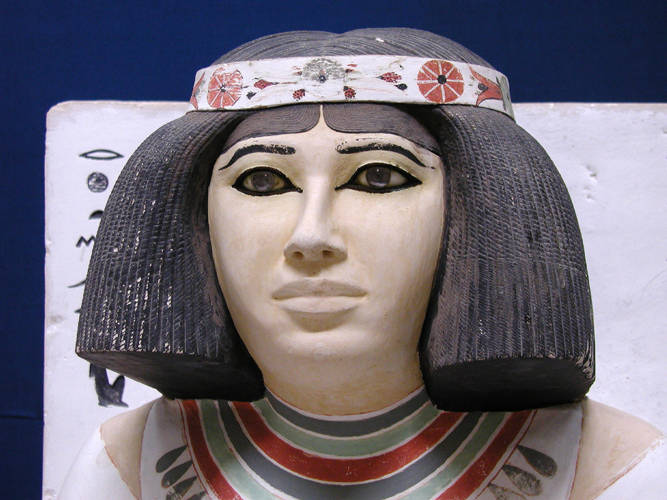
Another son of Sneferu and half-brother of Khufu is Rahotep, who was the High Priest of Re at Heliopolis.  He was married to a lady of unknown parentage called Nofret and they were buried in a mastaba tomb in Meidum. There is a very beautiful and lifelike painted statue of this couple in the museum in Cairo that was excavated from their mastaba. There are also sons and daughters of Sneferu that we still know relatively little about. Ranefer is known from his mastaba at Meidum. Kanefer held the titles of Vizier, High Priest and Overseer of the Troops. His tomb is situated in Dashur, which could indicate that he died after Rahotep and Nefermaat who were buried at Meidum, as during his reign Sneferu abandoned Meidum as a his possible burial place and started building pyramids at Dashur. It is also more than likely that they all predeceased their half-brother Khufu who went on to become the next pharaoh.


Nofret Statue
Nofret Statue

There is also another known son of Sneferu called Iynefer, about whom almost nothing is known and, of course, in the future the sands of Egypt may give up evidence of the existence of further members of this talented, powerful family. There are also some other daughters of Sneferu who we know a little about, such as Nefertkau who may have been married to her half brother Khufu.  She was the mother of Nefermaat II and was buried at Giza during the reign of the pharaoh Khafre. There was also a daughter called Nefertnesu whom very little is known about other than the fact that she had a son called Kaemqued.


So you are beginning to get the picture of how everything was very much all kept within the family, so that political power, military power, administrative power and religious power were all led and directed by members of the royal family for the benefit and prestige of pharaoh and the royal family?  It is perhaps unfortunate that all we know about this dynamic, powerful family comes from the formal inscriptions they have left behind on their tombs and monuments and that we can only guess at the politics, relationships and emotions that were generated between the various members of the royal family.

We can only conjecture that the royal ladies manoeuvred and plotted to get their sons ahead in the succession and high in pharaoh’s favour and we have no idea of how the royal princesses felt when they were married to their half-brothers. Was it a peaceful happy family living in accord or a turbulent, feuding one?  We will probably never know, but we can still go and see the amazing pyramid that Khufu built on the Giza plateau and those of his descendants Khafre and Menkaure and be bowled over by the accomplishments of this ancient family of overachievers.

Nofret Statue Wikimedia Commons any purpose

Saturday, 16 March 2013

Writer’s Block? Call on the Ancient Gods of Writing for Help


All of us writers have our days, or even weeks, when we feel like we are blocked. There are times when the words that usually flow so easily from our typing fingers are harder to find than gold nuggets on the bed of a fast flowing river.  So what can be done to release that writer’s block and get your creativity going again?  Well, if you have tried all the writing tips that you can now find out there on the internet and literally nothing is working for you, then maybe it is time to intercede with one of the ancient gods of writing and writers.

We tend to forget that it is only very recently that being able to read is regarded as a necessary skill that is taught to nearly all children from a young age.  In ancient times, writing was considered sacred.  The only people who could read and write were generally the priests who wrote and needed to interpret the sacred texts, perhaps the rulers and some members or the nobility and the scribes who ran the royal administration.


Thoth - Egyptian God of Writing - Medinet Habu


The Aten Sequence Books are set in Ancient Egypt where from pre-dynastic times they used a form of writing that we now call hieroglyphs.  This is a form of writing that consists of images, phonetic glyphs and determinatives that was used to carve the sacred texts on the walls of the temples, tombs and papyri.  The god that the Ancient Egyptians revered as the inventor of writing was Thoth, who was often depicted with the body of a man and the head of an ibis.  He is also frequently portrayed as an ibis or an ape, or sometimes as an ape with the face of a dog.  Thoth is a lunar deity, so is shown wearing the lunar disc and crescent on his head.  As well as inventing writing, he was credited with inventing medicine, astronomy and geometry. He counted the stars, charted the earth and was the guardian of all wisdom and recorder of all knowledge.   He was also seen as a psychopomp, as when Ancient Egyptians died they believed that they would meet Thoth in the Hall of Maat, where he would record the results of the weighing of their heart against the feather of Maat that determined whether or not they had lived a righteous life.


Uniquely in the ancient world however, during Ancient Egypt’s New Kingdom we do have a source of texts written by ordinary people.  The inhabitants of the workmen’s village at Deir el-Medina were literate as they were responsible for digging out and carving or painting the tombs of the pharaohs in the Valley of the Kings and decorating the walls of their mortuary temples.  The villagers would use flakes of limestone called ostraca and scraps of papyrus to record lists, keep accounts, send letters to friends and loved ones and generally record the gossip of the day.  Egyptologists have gleaned a great deal of information about the lives of these workmen and their families from these writings and it is perhaps the earliest instance where we can follow the goings on and lives of ordinary folk.

The centre of Thoth’s cult was at Hermopolis and during the late period of Ancient Egyptian history when the country was ruled by the Greek Ptolemy’s, Thoth became identified with the Greek god of writing Hermes and was worshipped as Hermes Trismegistus.  Hermes Trismegistus was known as the ‘thrice great’ and was associated with astrology and alchemy.  He is credited with writing philosophical or occult texts such as the Corpus Hermeticum and the Asclepius that are collectively known as Hermetica.  These texts enjoyed a revival in Europe during the Middle Ages and the Renaissance with the alchemists that were studying the occult, magic and also experimenting in turning base metals into gold.


Hermes Trismegistus
Hermes Trismegistus

Perhaps one of the oldest deities associated with writers and writing, who is still worshipped by millions today, is the elephant-headed Hindu god Ganesha.  His mother was the goddess Parvati who created her divine son by smearing her body with a paste made from herbs and sandalwood. She scraped this paste off her body, moulded it into the shape of a young boy and breathed her creation into life. Parvati then went to bathe and asked her new son to keep watch over the house.  While she was bathing, her husband the Lord Shiva returned home and fell into a rage when he was denied entry to his own home by an unknown boy.  His outrage was so great that he struck the boy’s head clean off his shoulders. When Parvati emerged from her bath she was grief stricken when she found out what had happened to her beloved child.  Such was her distress that Lord Shiva sent his retinue out to seek a new head for the body.


The first creature they came upon was an elephant, so they decapitated the animal and brought the head back to Lord Shiva, who then revived the boy by placing the head on his shoulders. But Parvati was still not consoled as she feared that Ganesha would be laughed at and disrespected by gods and mortals alike because of his elephant features. To appease his wife, Lord Shiva blessed Ganesha by proclaiming him to be the ‘Remover of Obstacles’ and that henceforth if you wanted success you had to offer up a prayer to the elephant-headed deity before starting projects and quests.

He is regarded as a deity that presides over writing and protects writers because he broke one of his own tusks, which he is portrayed as holding in his lower left hand, in order to inscribe the epic Mahabharata that was dictated to him by the sage Ved Vyasa.  He is worshipped as the god of knowledge, education, wisdom and prosperity and is depicted as a large-bellied man with the features, huge ears and curving trunk of an elephant seated on a rat.  His elephant head symbolises the soul and his human body our earthly incarnation and he pushes humanity to success by removing our obstacles.


Ganesha
Ganesha
So if you are having trouble with your latest writing project, why not ask for some help or a little push from one of these ancient deities?  Ritual and ceremony have long been used for personal growth and to help move our lives forward, so why not keep a picture or a small statue of your favourite writing deity on your desk to remind you to invoke their aid and tap into the ancient wisdom.  In some ways writing is alchemy, as writers take words and form them into different shapes and meanings, so perhaps it is not so surprising that words and writing were once regarded as sacred? And after all, who of us wouldn’t like a little help in achieving success?


Thoth at Medinet Habu - Own Image Hermes Trismegistus image Wikimedia Commons Public Domain Ganesha Image Khushi Wikimedia Creative Commons Attribution Share Alike 2.0 Generic